Explore the world of swimming
Swimming has a rare range: it can teach safety, build fitness, sharpen discipline, and still feel playful enough for a summer afternoon. Few activities serve so many purposes at once, which explains why schools, health clubs, and Olympic arenas all give it a place. In the sections ahead, you will find a clear outline and a practical look at technique, health effects, equipment choices, training environments, and smart habits that help swimmers progress with confidence.
Outline and the Lasting Appeal of Swimming
Before exploring the finer points of strokes and training, it helps to map the subject clearly. This article follows a simple outline: first, why swimming matters; second, how the major strokes work; third, what swimming can do for health and fitness; fourth, how gear and environment change the experience; and fifth, how readers can stay safe while improving over time. That outline mirrors the way many people actually enter the sport. They begin with curiosity, learn basic movement, notice the physical benefits, discover the practical side of equipment, and then decide whether swimming will become exercise, recreation, or serious training.
- Swimming as a life skill, sport, and leisure activity
- Technique and comparisons between major strokes
- Fitness, cardiovascular health, and mental well-being
- Equipment, pools, open water, and accessibility
- Safety, progression, and useful habits for long-term improvement
What makes swimming unusually relevant is its flexibility. A child may first meet it as a safety lesson, an adult may return to it after years away because it feels gentler on the joints than running, and a competitive athlete may treat it like a science of efficiency, tempo, and breath control. That broad range is not accidental. Water changes movement itself. Because it supports body weight while also resisting every motion, swimming can feel both forgiving and demanding at the same time. The pool does not shout, yet it tells the truth immediately: rushed movements waste energy, poor timing interrupts rhythm, and calm technique travels farther.
Swimming also holds a significant place in modern sport and public health. Competitive events range from local meets to world championships and the Olympic Games, while recreational swimming remains one of the most accessible forms of physical activity for mixed age groups. Municipal pools, hotel pools, school programs, beach clubs, and community centers all keep it within reach for millions of people. At the same time, water safety education remains important because drowning prevention depends heavily on supervision, skill, and respect for conditions.
In cultural terms, swimming has two personalities. One is measurable and exact, with stopwatches, split times, and lane discipline. The other is almost poetic: the silence under the surface, the steady pull of an arm through clear water, the brief feeling that gravity has loosened its grip. A strong article on swimming needs room for both views, because the subject is not only about motion. It is also about confidence, resilience, and the satisfying moment when awkward splashing turns into smooth forward travel.
Understanding the Main Strokes and the Mechanics of Movement
Swimming looks graceful from the deck, but in the water it is a careful negotiation between propulsion, balance, timing, and breath. The four competitive strokesfreestyle, backstroke, breaststroke, and butterflyeach solve the same problem in a different way: how to move the body efficiently through a medium that is far denser than air. Freestyle, usually swum with a front crawl technique, is the fastest and most commonly taught for fitness. It relies on a long body line, alternating arm recovery, a flutter kick, and rhythmic side breathing. When done well, it feels almost like sliding downhill, except the hill is invisible and built from timing.
Backstroke flips that logic onto the swimmer’s back. Because the face remains above the surface, breathing is simpler than in freestyle, yet orientation can be harder because swimmers cannot easily see where they are going. Good backstroke depends on a stable hip position, shoulder rotation, and a continuous kick that prevents the legs from sinking. Breaststroke is different again. Its pull and kick work in a more symmetrical pattern, and the stroke includes a glide phase that rewards patience. Many beginners like breaststroke because the head rises regularly, but technically it can be demanding; timing the kick too early or too late quickly reduces speed.
Butterfly is often viewed as the most dramatic stroke. It uses simultaneous arm recovery and a dolphin kick powered through the core and hips. To spectators, butterfly can look like pure force, but strong butterfly is actually about rhythm. Swimmers who muscle through it tend to tire quickly, while those who connect the kick, chest movement, and arm pull create a smoother wave.
A few technical principles appear across all strokes:
- Body position matters because a horizontal line reduces drag.
- Breathing should support rhythm rather than interrupt it.
- Kicking stabilizes the body as much as it provides propulsion.
- Efficient catches and pulls move water backward so the swimmer moves forward.
Beginners often overestimate the role of force and underestimate the value of alignment. A tense neck, dropped elbow, or lifted head can slow a swimmer more than expected. That is why coaches repeat simple cues such as “look down,” “stay long,” and “finish the stroke.” These are not empty slogans. They are reminders that water rewards precision. Compared with land sports, the feedback is immediate and physical: if technique breaks, momentum disappears. Once swimmers understand that, training becomes less about fighting the water and more about cooperating with it.
Health, Fitness, and the Mental Rewards of Time in the Water
Swimming earns its reputation as a strong all-around exercise because it blends cardiovascular work with muscular endurance in a low-impact setting. Many forms of movement emphasize one quality over another, but swimming asks the heart, lungs, shoulders, back, core, and legs to work together continuously. For people who want exercise that feels serious without constant pounding on the joints, that combination is hard to ignore. Water buoyancy reduces some of the impact seen in activities such as road running, while water resistance means the body still has to work through every stroke.
From a fitness perspective, swimming can be scaled to very different goals. Easy laps may support general activity and recovery, interval sets can raise aerobic capacity, and sprint work challenges power and speed. Public health guidance commonly recommends at least 150 minutes of moderate aerobic activity per week for adults, and swimming can fit neatly into that target. Calorie expenditure varies widely by body size, stroke, and intensity, but moderate lap swimming often burns a meaningful amount of energy, while vigorous sessions can be comparable to other demanding endurance workouts. The advantage is not just the energy cost; it is the full-body involvement that makes each session productive.
The benefits are not only physical. Many swimmers describe the water as mentally clarifying. The repetitive pattern of stroke, breath, and turn can create a focused state that resembles moving meditation. Unlike noisier gym settings, a pool often narrows attention to a few essentials: the line at the bottom, the rhythm of breathing, the count to the wall. For some people, that structure reduces stress because it limits distraction. For others, it builds confidence. Learning to float, coordinate breathing, or complete a full length of the pool can be deeply encouraging, especially for adults who once felt uneasy around water.
Swimming also compares favorably with other forms of exercise in several practical ways:
- It can be adapted for beginners, older adults, and competitive athletes.
- It trains endurance without repeated impact on ankles, knees, and hips.
- It develops posture and body awareness through controlled movement.
- It can be social in lessons, clubs, and masters programs, or solitary for those who prefer quiet training.
None of this makes swimming magical, and it should not be sold that way. It still requires consistency, instruction, and sensible progression. Yet its broad usefulness is real. Few activities can serve as exercise, stress relief, recreation, and skill development in the same hour. That versatility is one reason swimmers often stay with it for decades, even if their goals change along the way.
Gear, Training Environments, and Why Context Changes the Experience
Swimming may appear simple because the basic equipment list is short, but the environment and gear choices shape the experience more than many beginners expect. A swimsuit, goggles, and access to water are enough to start, yet serious comfort and steady progress usually depend on a better understanding of context. Pool length matters, temperature matters, visibility matters, and the difference between a calm lap lane and open water can feel like the difference between a hallway and a wide, windy field.
In pools, the most common formats are 25-yard, 25-meter, and 50-meter lengths. That detail changes pacing, turn frequency, and how people judge distance. Shorter pools mean more walls and push-offs, which can make sets feel faster. Longer pools demand uninterrupted stroke rhythm and often feel more honest. Indoor pools offer predictability: lane lines, marked depths, controlled temperature, and usually lifeguard coverage. They are ideal for technique work, interval training, and beginners who need a stable learning space. Outdoor pools add weather and sunlight, which can make the session more vivid but also more variable.
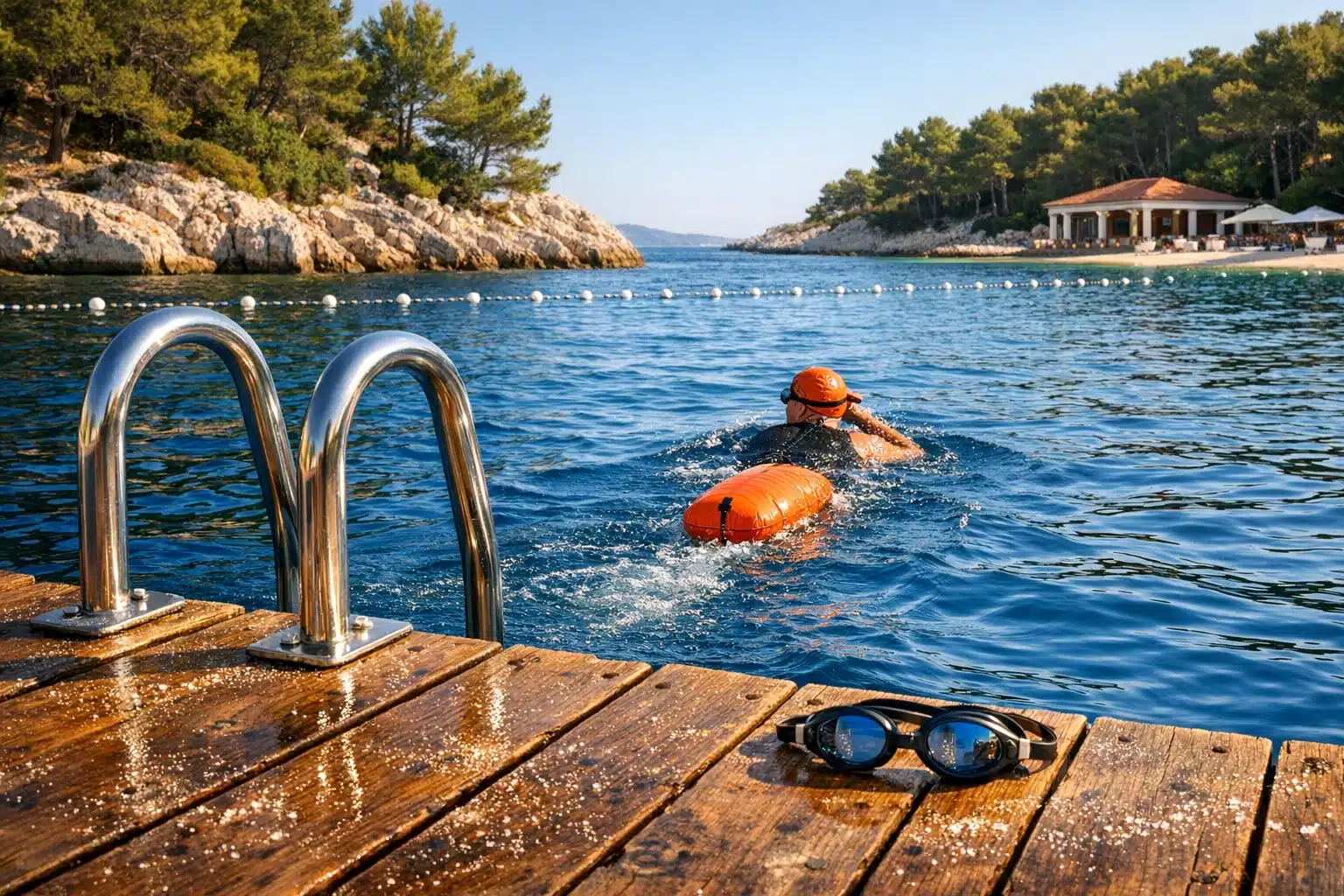
Open water introduces a new set of demands. Lakes, rivers, and the sea remove black lines, walls, and often the comfort of perfectly clear conditions. Swimmers must learn sighting, navigation, and how to remain calm when waves, current, or cold water change the feel of every stroke. For experienced swimmers, that unpredictability can be thrilling. For novices, it can be intimidating enough to disrupt technique. Neither reaction is unusual.
Equipment can support skill development when used intelligently:
- Goggles improve visibility and reduce eye irritation.
- Caps can reduce drag slightly and help manage hair.
- Kickboards isolate leg work, though overuse can strain the neck if posture is poor.
- Pull buoys shift emphasis toward the upper body and body position.
- Fins can help beginners feel better alignment and ankle-driven kick patterns.
Accessibility is also part of the conversation. Swimming can be welcoming, but access is not equal everywhere. Pool fees, lesson costs, transportation, and limited local facilities can all become barriers. On the other hand, many community programs, school lessons, and public recreation centers are designed to lower those barriers. Adaptive instruction and water-based exercise classes have also expanded participation for people with different physical needs. In that sense, swimming is not only about water and movement. It is also about infrastructure, instruction, and whether communities treat aquatic skill as a luxury or a public good.
A Practical Conclusion for Beginners, Parents, and Returning Swimmers
If there is one principle that should guide anyone exploring swimming, it is this: confidence grows best when skill and safety develop together. Too many people separate the two, treating technique as the interesting part and safety as a formality. In reality, they reinforce each other. A swimmer who knows how to breathe calmly, float, tread water, and rest efficiently is not only safer but also more capable of learning faster strokes and longer distances. For parents, this means lessons should build comfort before speed. For adults returning to the pool, it means patience is not weakness; it is the foundation for enjoyable progress.
Basic safety habits remain essential in every setting. Pools should have clear rules, supervised children, and attention to depth changes. Open water requires even more caution because current, cold, boat traffic, and limited visibility can escalate risk quickly. Even strong swimmers benefit from a buddy, a designated swim area, and an honest reading of conditions. Skill is valuable, but judgment is what prevents trouble.
- Learn floating, controlled breathing, and basic treading before chasing distance.
- Respect weather, water temperature, and local warnings in outdoor settings.
- Increase volume gradually rather than doubling distance in a single week.
- Use lessons or coaching if the same technical mistake keeps returning.
- Treat rest, hydration, and recovery as part of training, not as afterthoughts.
A practical improvement plan does not have to be elaborate. Two or three sessions per week can be enough for noticeable progress if the work is structured. One session might focus on easy endurance, another on drills and breathing, and a third on short intervals with generous rest. That kind of variety keeps training from becoming a dull march up and down the lane. It also helps swimmers understand that progress is not measured only by speed. Better timing, smoother turns, calmer breathing, and improved comfort in deeper water are all meaningful gains.
For the target audience of this articlewhether you are a beginner, a parent choosing lessons, or someone returning to exercise after a long breakthe main takeaway is reassuring. Swimming does not demand that you start as graceful, fearless, or fast. It asks only that you begin carefully and keep learning. Over time, the water stops feeling like an obstacle and starts feeling like a partner. That shift is the real reward: not simply covering more lengths, but discovering a skill that can support health, confidence, recreation, and enjoyment for years to come.