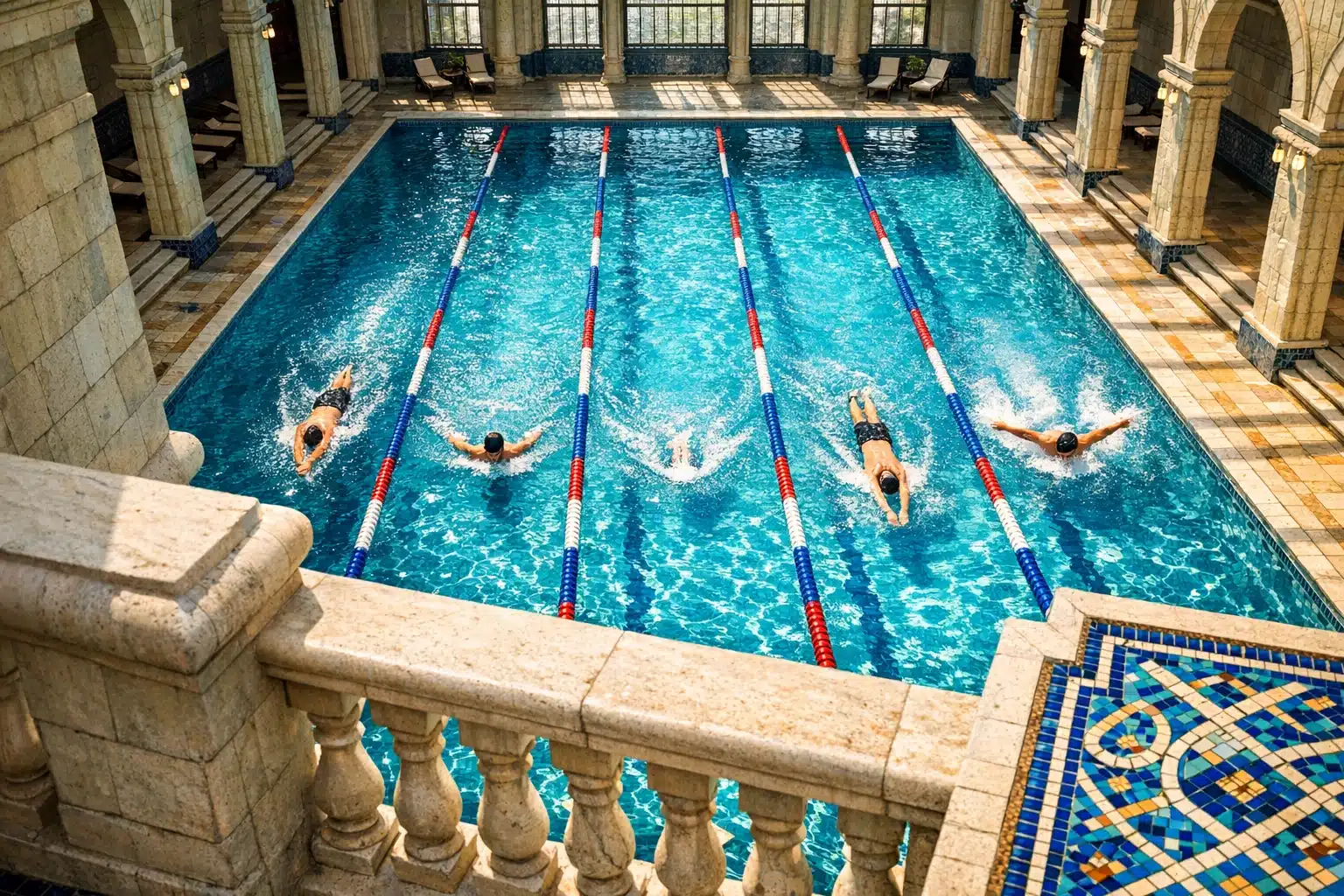
Explore the world of swimming
Swimming sits at the meeting point of survival, sport, and simple joy, making it one of the few activities that can be practical on Monday, competitive on Wednesday, and deeply calming by the weekend. It asks the body to work with water instead of against it, rewarding patience, rhythm, and good technique. Whether you are curious about fitness, safety, or performance, the subject stays relevant from childhood lessons to healthy aging.
Article Outline
- The importance of swimming as a life skill, sport, and leisure activity
- The main strokes and how they differ in technique, purpose, and difficulty
- The physical and mental benefits of swimming across age groups
- How to learn, train, choose equipment, and improve efficiently
- Safety, community, and how to build a lasting relationship with the water
Swimming as a Life Skill, a Sport, and a Source of Freedom
Swimming deserves attention for a simple reason: few human activities combine usefulness and pleasure so naturally. At its most basic level, swimming is a safety skill. Knowing how to float, breathe calmly, and move toward an edge can reduce risk in pools, lakes, rivers, and coastal settings. That alone makes instruction valuable. Yet swimming quickly becomes more than emergency preparation. It can turn into recreation, exercise, competition, and even a form of quiet reflection. For some people, stepping into water feels like entering a second landscape, one where the body is lighter, sound changes, and movement gains a smooth, almost musical quality.
As a sport, swimming is remarkably broad. It includes beginner lessons, lap swimming, school programs, masters clubs, open-water events, triathlon training, and elite competition. Pool swimming is often associated with measured precision: lane lines, split times, and exact distances. Open-water swimming, by contrast, brings a wilder character. Currents, temperature, visibility, and navigation all influence performance. One is like writing with a ruler; the other is like sketching in the wind. Both demand skill, but they challenge the swimmer in different ways.
Swimming is also unusually inclusive. Because water supports body weight, it is often easier on joints than many land-based activities. That can make it attractive to older adults, people returning from injury, or beginners who find running uncomfortable. At the same time, advanced swimmers can make sessions extremely demanding by increasing pace, distance, or technical difficulty. In other words, the same medium welcomes both recovery and high performance.
Its relevance also extends beyond sport culture. Swimming lessons are common in childhood education, lifeguard training, military preparation, and rehabilitation settings. The environment teaches discipline in a practical way. A swimmer cannot argue with poor breathing rhythm or sloppy body position; the water gives immediate feedback.
- It develops confidence through visible progress
- It encourages body awareness without requiring heavy impact
- It can be practiced for health, competition, or enjoyment
This combination of safety, adaptability, and challenge explains why swimming remains important across generations. It is not just an activity people do. It is a skill that can accompany a person for life, changing its meaning as circumstances change. One season it is training, another it is therapy, and on a hot afternoon it is simply freedom with a blue surface.
Understanding the Main Strokes: Technique, Purpose, and Personality
To understand swimming well, it helps to look closely at the four competitive strokes: freestyle, backstroke, breaststroke, and butterfly. Each has a distinct rhythm, technical demand, and practical use. Freestyle, usually swum with the front crawl, is the fastest and most efficient for most people over distance. Its alternating arm action and flutter kick create a streamlined motion that rewards balance and breathing control. Good freestyle often looks easy from the deck, but that ease is usually the result of careful technique: a long body line, a steady kick, high elbows underwater, and breathing that does not disrupt alignment.
Backstroke is the only stroke performed on the back, which changes orientation and breathing. Because the face stays above water, some beginners find it less stressful at first. However, it introduces new challenges, especially straight-line navigation and shoulder coordination. A swimmer doing backstroke must trust body position without looking forward, almost like walking through a familiar room in the dark and learning that memory matters as much as sight.
Breaststroke is often the most recognizable stroke to casual swimmers. Its pull, breath, kick, and glide pattern gives it a measured tempo that can feel natural to learners. It is usually slower than freestyle and backstroke, but speed is not its only value. Breaststroke can teach timing, patience, and efficiency. If rushed, it becomes tiring. If paced correctly, it becomes elegant and surprisingly economical.
Butterfly is the most dramatic of the four. Both arms move together, the body undulates, and the kick usually comes from a dolphin motion generated through the core and hips. It is powerful, demanding, and technically unforgiving. Many new swimmers assume butterfly is only about strength, but good butterfly is actually about timing. When the wave of the body, the arm recovery, and the breath line up, the stroke looks less like struggle and more like release.
Each stroke trains the swimmer differently:
- Freestyle favors sustained speed and efficiency
- Backstroke improves posture awareness and shoulder coordination
- Breaststroke highlights timing and controlled propulsion
- Butterfly develops rhythm, power, and full-body integration
Learning all four matters even for non-competitive swimmers. Variety reduces monotony, challenges different muscle groups, and builds a deeper understanding of how water behaves. It also reveals an important truth: swimming is not one movement but a family of techniques, each with its own logic. The better a swimmer understands those differences, the more intelligently they can train, adapt, and enjoy the water.
The Physical and Mental Benefits of Swimming
Swimming has earned its reputation as a balanced form of exercise because it trains several systems at once. It improves cardiovascular endurance, challenges muscular coordination, and does so in an environment shaped by buoyancy and resistance. Water is much denser than air, so every stroke meets resistance in multiple directions. That means even moderate swimming can become a meaningful whole-body session. The arms pull, the legs drive, the core stabilizes, and the lungs learn to work within a controlled breathing pattern rather than an automatic one.
One of swimming’s biggest strengths is that it can fit a wide range of fitness goals. A relaxed continuous swim may support general aerobic health. Faster interval training can raise intensity and improve speed or conditioning. Technique drills can refine movement economy. Public health guidelines commonly recommend at least 150 minutes of moderate aerobic activity per week for adults, and swimming can help people meet that target while avoiding the repetitive impact associated with some land sports. For individuals with joint discomfort, excess body weight, or a need for low-impact training, this is often a practical advantage rather than a minor bonus.
The mental side is equally important. Swimming asks for concentration, especially on breathing, body position, and rhythm. That focus can create a calming effect similar to active meditation. In a noisy routine full of alerts, screens, and rapid shifts of attention, the lane offers a strange luxury: repeated movement with clear purpose. Even a short session can feel like a reset. Many swimmers describe the sensation of counting strokes or exhaling underwater as a way of quieting mental clutter.
There are also benefits tied to consistency and confidence. Because progress in swimming is often measurable, motivation can stay tangible. A swimmer may notice that 25 meters becomes easy, then 100 meters feels manageable, then technique starts to feel smoother. Improvement arrives in layers.
- Better endurance often appears before obvious speed gains
- Improved breathing control can increase confidence in daily activity
- Regular practice may support stress management and sleep quality
Of course, swimming is not automatically perfect for everyone. Pool access, water temperature, scheduling, and learning anxiety can be barriers. Technique flaws may also create frustration or inefficient effort. But when those issues are addressed with patience, swimming becomes one of the rare activities that can serve rehabilitation, recreation, and athletic ambition all at once. It works like a quiet engine: steady, efficient, and stronger than it first appears.
Learning to Swim, Training Smarter, and Choosing the Right Equipment
Many people assume swimming improvement comes mainly from doing more laps. In reality, progress is usually faster when practice is built on technique, structure, and honest feedback. For beginners, the first milestones are not speed and distance but comfort in the water. Learning to submerge the face, exhale underwater, float on the front and back, and recover from mild disorientation creates a foundation that later strokes depend on. Without those basics, swimmers often develop tension patterns that make everything harder than it needs to be.
Once confidence improves, training can become more purposeful. A balanced session often includes a warm-up, drills, a main set, and an easy cool-down. Drills are especially valuable because they isolate parts of the stroke. A freestyle swimmer, for example, might practice side kicking to improve balance or fingertip-drag recovery to reinforce a cleaner arm path. These small pieces matter. In swimming, a slight change in head position or hand entry can noticeably affect drag and rhythm.
Equipment helps, but it should support skill rather than replace it. A comfortable swimsuit and a well-fitting pair of goggles are the essentials. Caps can reduce drag and keep hair controlled. Kickboards help isolate leg work, while pull buoys reduce kicking demand so swimmers can focus on the upper body. Fins can improve body position and let learners feel propulsion more clearly, though overreliance is not ideal. Paddles add resistance for stronger swimmers, but they should be used carefully to avoid shoulder strain.
Training goals can vary widely:
- A beginner may focus on floating, breathing, and 25-meter comfort
- A fitness swimmer may build endurance through steady sets and intervals
- A competitive swimmer may target split times, turns, starts, and race pace
Common mistakes appear at every level. New swimmers often lift the head too high when breathing, causing the hips to sink. More experienced swimmers may chase distance while ignoring technique, effectively rehearsing inefficiency. Others train too hard too often and lose the quality needed for real improvement. Good coaching, video feedback, or even occasional self-observation can prevent those habits from settling in.
The smartest approach is usually progressive and specific. Increase difficulty gradually. Alternate harder sessions with lighter work. Pay attention to stroke quality, not just volume. Swimming rewards patience in a very direct way. You cannot bully the water into giving you speed. You learn to move through it more cleanly, and when that happens, progress feels less like brute force and more like unlocking a hidden gear.
Safety, Community, and Conclusion for New and Returning Swimmers
Any serious discussion of swimming should end where wise participation begins: safety. Water is inviting, but it is never trivial. Strong swimmers can still misjudge fatigue, cold, depth, currents, or changing conditions. Beginners may feel secure in shallow water and panic the moment footing disappears. That is why good habits matter in every setting, from a public pool to an open lake. Learning how to tread water, float, enter and exit safely, and recognize personal limits is not optional background knowledge; it is part of the activity itself.
Pool swimming and open-water swimming require different safety thinking. In pools, risks often involve collisions, slippery decks, poor supervision, or overestimating endurance. In open water, complexity rises quickly. Visibility may be limited, distances can feel deceptive, and wind or currents may change conditions mid-swim. Bright swim buoys, partners, designated areas, and local knowledge become important tools rather than accessories. Even confident swimmers benefit from caution, because experience should sharpen respect, not erase it.
Swimming also has a social side that people sometimes overlook. Lessons build trust between instructor and learner. Club practices create routine and accountability. Masters groups give adults a place to improve without needing elite goals. Family swims turn skill into shared leisure. In that sense, swimming is personal but rarely isolated. It often flourishes in communities where encouragement, etiquette, and safety culture are visible. A good lane-sharing environment can teach cooperation as effectively as any formal rulebook.
- Start with realistic goals and celebrate technical progress
- Choose environments that match your confidence and skill level
- Respect fatigue, weather, and water conditions every time you swim
For the target audience of new swimmers, returning adults, and fitness-minded readers, the main message is simple: swimming is worth learning well. It can improve health, widen recreational options, and build practical confidence that reaches beyond sport. You do not need to chase medals for swimming to matter. A few well-taught skills, steady practice, and careful safety habits can already change your relationship with water. Over time, the pool or shoreline stops feeling like a place you visit cautiously and starts feeling like a place you understand. That shift is where enjoyment deepens, progress becomes sustainable, and swimming turns from an occasional activity into a durable part of life.