Explore the world of swimming
Swimming sits at a rare crossroads where survival, sport, therapy, and enjoyment share the same space. A child learning to float, a triathlete sharpening endurance, and an older adult protecting sore joints can all find something valuable in the water. Because the body moves differently when supported by buoyancy, swimming builds skill through breath, balance, timing, and patience rather than impact alone. That unusual combination keeps it relevant to health, recreation, confidence, and performance across a lifetime.
Outline
- The foundations of swimming and why it matters in daily life, sport, and public safety.
- The main strokes, how they differ, and the technical details that shape efficiency.
- The physical and mental benefits of swimming, including fitness, recovery, and stress relief.
- Safety, training methods, equipment, and the practical difference between pools and open water.
- Swimming as a lifelong activity through competition, community, inclusion, and personal growth.
Swimming as a Fundamental Human Skill and Modern Sport
Swimming is often introduced as recreation, yet at its core it is one of the most useful movement skills a person can learn. Unlike activities that exist mainly for competition or exercise, swimming carries a practical dimension that reaches far beyond the lane line. Knowing how to stay afloat, control breathing, and move calmly through water can increase personal safety around beaches, rivers, pools, and boats. Public health organizations regularly emphasize water competence for this reason, especially because drowning remains a serious global problem. That reality gives swimming a relevance few sports can match.
Its appeal, however, does not come only from necessity. Swimming also occupies a special place in human culture because it can feel meditative and athletic at the same time. On land, gravity dominates every stride and jump. In water, the body enters a different conversation with physics. Buoyancy reduces the stress placed on joints, while resistance from the water turns even smooth motions into meaningful work. This is why a gentle session can feel restorative, while a faster set can challenge the heart and lungs with surprising intensity.
Modern swimming spans many forms. Some people swim for leisure during warm afternoons. Others approach it as structured training, logging distances and refining technique. Competitive swimmers race in pools over set distances using four recognized strokes, while open water swimmers face currents, changing temperatures, and the psychological challenge of depth and distance. Then there are people who use swimming in rehabilitation, adaptive sport, or low-impact conditioning. Few activities welcome such a broad range of participants with equal legitimacy.
Swimming also rewards patience in a way that many beginners do not expect. Progress is not simply about becoming stronger; it often depends on becoming more coordinated. A person who fights the water usually tires quickly, while a swimmer who learns alignment and timing can move farther with less effort. This creates an unusual lesson: efficiency can matter as much as power. That principle makes swimming intellectually satisfying, not just physically demanding.
Several factors explain why swimming remains so widely valued:
- It combines safety, exercise, and recreation in one skill.
- It suits many ages and fitness levels.
- It can be social, solitary, competitive, or therapeutic.
- It offers progress through technique, not only through force.
In short, swimming matters because it meets people where they are. It can be a first lesson in confidence, a lifelong sport, a recovery tool, or simply a quiet hour in the water after a noisy day. Few pursuits carry that much range without losing their identity.
Understanding the Main Strokes and the Craft of Good Technique
To someone watching from the deck, all swimmers may seem to be doing the same thing: moving from one end of the pool to the other. In practice, stroke choice changes everything. Each stroke asks the body to solve the same problem in a different way, balancing propulsion, drag, rhythm, and breathing. Learning these differences helps swimmers train more effectively and appreciate why certain strokes feel natural while others seem almost theatrical.
Freestyle, usually swum with the front crawl, is the fastest and most commonly practiced stroke. Its efficiency comes from a streamlined body position, alternating arm recovery, flutter kick, and side breathing. Because the body stays long and horizontal, it cuts through the water with relatively low resistance. Freestyle is often the first stroke used for fitness training because it supports sustained pace and clear progress over distance.
Backstroke flips the swimmer onto the back and changes the sensory experience completely. The face stays out of the water, which simplifies breathing, but orientation becomes harder because the swimmer cannot easily see where they are going. Good backstroke depends on hip rotation, shoulder mobility, and a steady kick. Many beginners enjoy the freedom of breathing, yet they must learn body alignment to prevent sinking hips and wandering direction.
Breaststroke is slower than freestyle but often feels more intuitive to new swimmers because the timing is visibly structured. The arms sweep outward and inward, the legs perform a whip kick, and the head typically rises forward during the breathing phase. However, breaststroke is technically demanding in its own way. Mistimed kicks or wide arm pulls create large amounts of drag. When done well, it is economical and smooth; when done poorly, it becomes tiring and inefficient.
Butterfly is the most dramatic stroke, powerful and rhythm-heavy, with both arms recovering together and a dolphin kick driving the body forward. It requires coordination, mobility, and strong timing between the upper body and core. Many people see butterfly as the hardest stroke, not because it is impossible, but because it punishes poor timing quickly. It is the stroke that makes water look like a stage and the swimmer like part engine, part percussion instrument.
A simple comparison highlights the differences:
- Freestyle: fastest, versatile, best for endurance work.
- Backstroke: easier breathing, useful for posture and shoulder balance.
- Breaststroke: slower pace, distinct timing, often beginner-friendly at first glance.
- Butterfly: highest coordination demand, excellent for power and rhythm.
Across all strokes, technique depends on a few shared principles: body position, controlled breathing, efficient catch, and kick that supports rather than disrupts motion. This is why coaching matters. A small adjustment, such as turning the head less during a breath or keeping the elbow higher in the pull, can produce a noticeable improvement. Swimming rewards detail. In the water, centimeters matter, seconds matter, and calm movement usually wins over struggle.
Health, Fitness, and the Quiet Power of Water
Swimming has long been praised as a full-body workout, but that label only hints at what makes it so useful. It trains the cardiovascular system, challenges multiple muscle groups, improves coordination, and does all of this in an environment that reduces impact on the skeleton and joints. For people who find running too jarring or certain gym exercises uncomfortable, water often feels like a practical compromise that does not sacrifice effectiveness.
From a fitness perspective, swimming can support both aerobic and anaerobic development. Longer continuous swims build endurance and strengthen the heart and lungs. Faster intervals, such as repeated sprints with short rest, raise intensity and can improve speed, power, and work capacity. Because water is much denser than air, every stroke meets resistance. That means even controlled, graceful swimming asks the body to produce force throughout the movement. It is resistance training disguised as rhythm.
The benefits extend beyond athletic performance. Water’s buoyancy can reduce the load on the body substantially, which is why swimming and aquatic exercise are often recommended for people managing arthritis, recovering from injury, or returning to activity after long periods of inactivity. Hydrostatic pressure, the pressure exerted by water on the body, may also support circulation and create a feeling of physical containment that many swimmers find calming. This partly explains why a session in the pool can leave someone both energized and relaxed.
Mental well-being is another major reason people keep coming back. Swimming imposes a natural structure: inhale, exhale, reach, rotate, kick, repeat. That sequence can quiet mental clutter. Many swimmers describe the experience as a moving form of focus, almost like a conversation between breath and distance. In a world full of alerts and interruptions, the pool asks for singular attention. That can be refreshing in a way statistics do not fully capture.
Compared with other common activities, swimming offers a distinctive package:
- Compared with running, it generally places less impact on knees and hips.
- Compared with cycling, it engages the upper body more directly.
- Compared with many gym circuits, it blends endurance and coordination more naturally.
- Compared with walking, it can challenge the cardiovascular system more intensely in less time.
Health authorities commonly recommend at least 150 minutes of moderate physical activity per week for adults, and swimming can contribute meaningfully to that target. It can also support weight management, mobility, and better sleep when practiced consistently. Still, its real strength may be sustainability. Many exercises lose appeal when soreness, boredom, or overuse appear. Swimming tends to remain available across different life stages. It can meet a teenager chasing performance, a parent looking for stress relief, or an older adult protecting movement quality. Water does not erase effort, but it changes its texture, making hard work feel smoother and often more inviting.
Safety, Training, and the Difference Between Pool Water and Open Water
Swimming becomes far more enjoyable when safety and training are treated as part of the same conversation. Confidence in the water should never be confused with carelessness. Even strong swimmers can run into trouble through fatigue, cold exposure, poor visibility, cramping, or simple misjudgment. This is especially true outside the pool, where the environment adds variables that technique alone cannot solve.
In a pool, conditions are controlled. The distance is marked, the depth is known, lifeguards may be present, and walls offer predictable rest points. That makes pools ideal for learning, measuring progress, and refining stroke mechanics. A beginner can focus on floating, breath control, and body position without also managing waves or current. Training plans are easier to structure as well. Swimmers can organize sessions around warm-up, drills, main sets, and cool-down, building skill in manageable pieces rather than through random effort.
Open water tells a different story. Lakes, rivers, and oceans introduce sighting, temperature shifts, currents, chop, and the mental challenge of swimming without lane lines beneath you. Distances can feel longer because visual reference points are less precise. Breathing may need to adjust to waves, and pacing must become more conservative. A swimmer who feels relaxed in a pool may be surprised by how disorienting open water can feel at first. This is not a sign of weakness; it is a normal response to a less predictable setting.
Some basic safety habits are worth treating as non-negotiable:
- Never overestimate your ability, especially in unfamiliar water.
- Learn to float, tread water, and rest without panic.
- Swim with a partner or in supervised areas whenever possible.
- Check weather, currents, and water temperature before open water swims.
- Use visible gear such as bright caps or tow floats when appropriate.
Training smart matters just as much as staying safe. Many new swimmers make the same mistake: they try to power through the water before learning how to move efficiently. A better approach is to build from fundamentals. Drills for kicking, breathing, balance, and catch mechanics often produce more progress than endless tired laps. Rest intervals are also useful. Unlike casual splashing, structured swimming places real demand on the shoulders, core, and lungs.
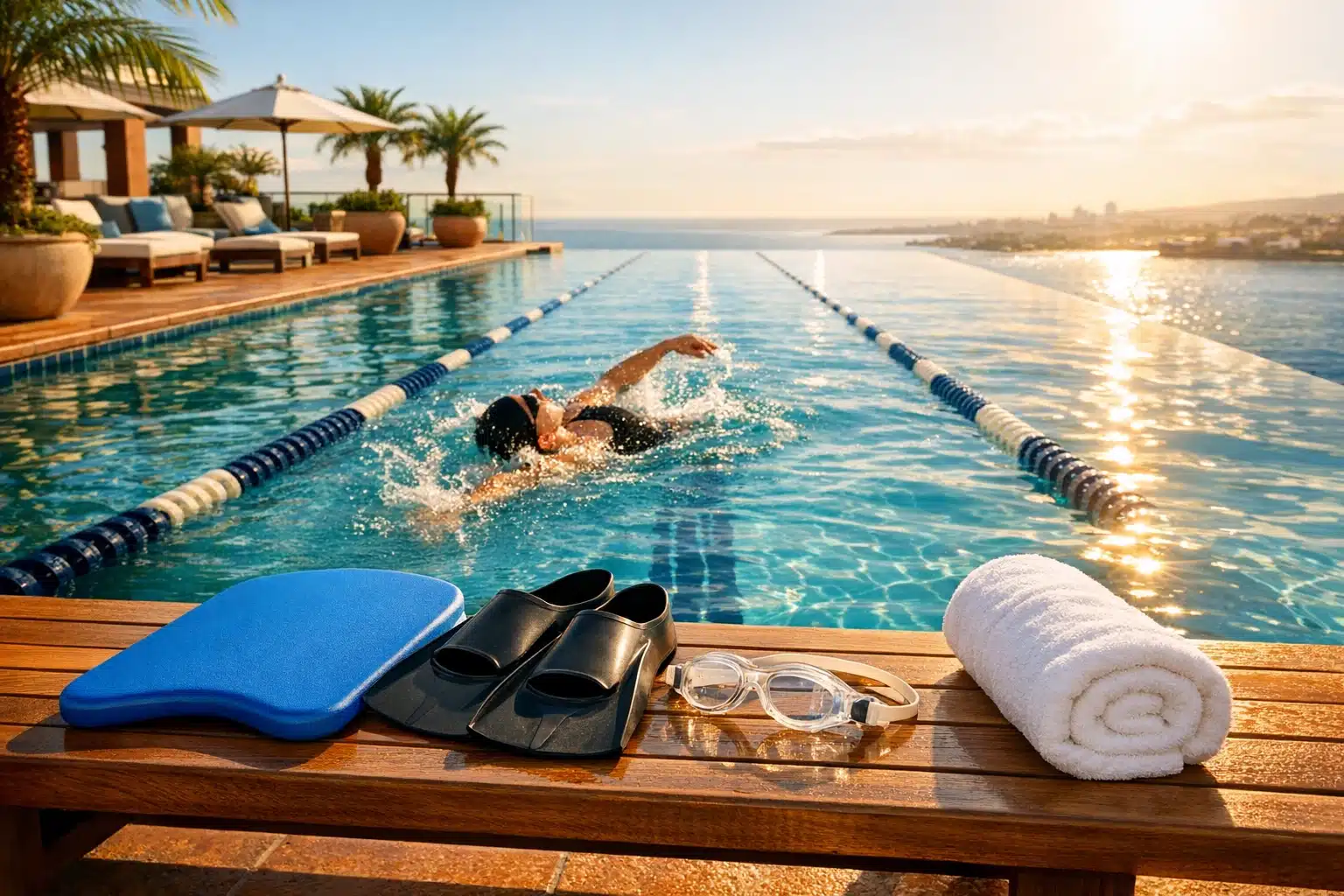
Equipment should support learning rather than replace it. Goggles improve visibility and comfort. A kickboard isolates lower-body work. Pull buoys can help focus on arm mechanics, and fins may assist with body position and ankle mobility. None of these tools are magic, but each can sharpen awareness when used thoughtfully.
Good swimming is not about pretending the water is harmless. It is about respecting the environment enough to prepare for it. When skill, caution, and practice meet, the experience becomes not only safer but far more satisfying.
Swimming for Life: Competition, Community, and Personal Growth
One of swimming’s greatest strengths is that it does not expire at a certain age or ability level. Many sports narrow as people grow older, recover from injuries, or lose interest in intense competition. Swimming tends to widen instead. It offers room for the ambitious athlete, the cautious beginner, the recreational lap swimmer, the triathlete, the child in lessons, and the older adult searching for a form of movement that still feels kind to the body.
Competitive swimming gives the sport much of its public visibility. Pool racing is precise and unforgiving: starts, turns, underwater phases, and finishing touch can decide results by fractions of a second. Events range from explosive sprints to longer races that test pacing and composure. Open water racing adds another dimension, where navigation, drafting, and environmental judgment matter alongside fitness. Spectators may see only speed, but swimmers know the truth: excellence is built through repetition so detailed it becomes almost invisible.
Beyond competition, swimming creates community in quieter ways. Local pools often become gathering points where people share lanes, training advice, milestones, and routines. Learn-to-swim programs help children build confidence early. Masters swimming welcomes adults who want coaching and structure without requiring elite status. Adaptive swimming programs make the sport more accessible to people with disabilities, proving that water can be a place of possibility rather than exclusion. These communities matter because skill grows faster when encouragement is present.
Swimming also teaches transferable lessons. Progress is rarely dramatic from one day to the next, so consistency becomes essential. Improvement often arrives in subtle forms: fewer strokes per length, calmer breathing, smoother turns, or the sudden realization that a distance once feared now feels manageable. Those moments build self-trust. The swimmer learns that patience can produce visible change, even when progress is quiet at first.
For many people, the long-term value of swimming comes down to a few lasting qualities:
- It supports health without demanding heavy impact.
- It can be practiced recreationally or competitively.
- It encourages discipline, body awareness, and resilience.
- It creates opportunities for social connection and lifelong learning.
There is something memorable about the end of a good swim. The noise of the day seems slightly farther away, the breath steadies, and the body feels worked without feeling punished. That afterglow helps explain why swimmers return, season after season. For the target audience of this topic, whether beginner or experienced, the most useful takeaway is simple: swimming is worth learning well because it gives back in many forms. It offers safety, fitness, challenge, calm, and community, and few activities deliver all of those benefits with such lasting relevance.