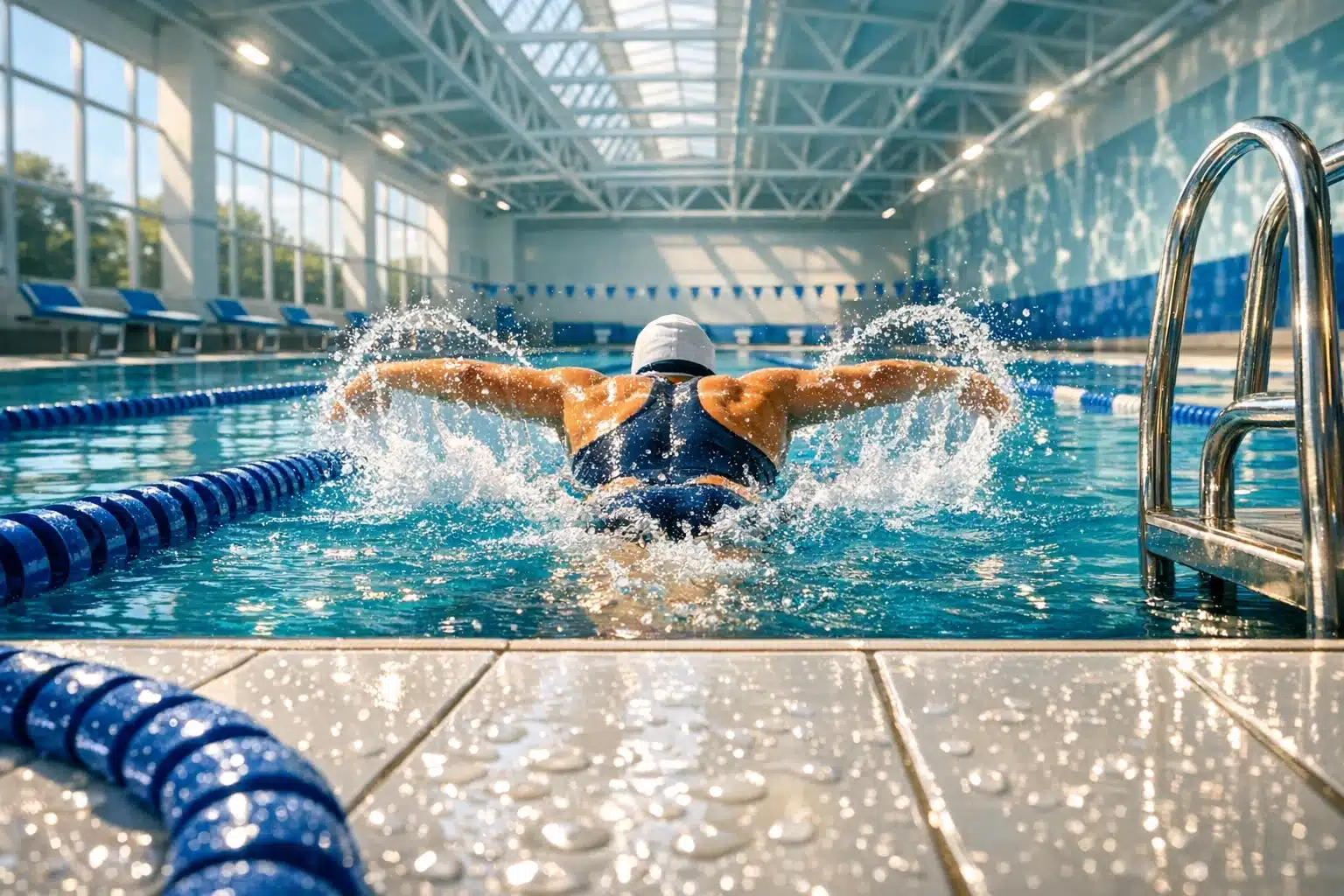
Explore the world of swimming
Swimming is one of those rare activities that can feel playful on the surface yet deliver serious benefits underneath. It builds endurance, strengthens major muscle groups, and challenges the lungs without the pounding that often comes with land-based exercise. Whether you enter the water to train, recover, compete, or simply reset after a long day, swimming offers a world of skill, rhythm, and calm worth exploring.
Article Outline
- Why swimming matters for fitness, recovery, and mental well-being
- How the four main strokes differ in technique, purpose, and difficulty
- What effective swim training looks like for beginners and improving athletes
- How to stay safe and confident in pools, lakes, rivers, and the sea
- Why swimming remains valuable as a lifelong sport, hobby, and community activity
Why Swimming Matters: Health, Movement, and Everyday Value
Swimming has a broad appeal because it combines cardiovascular training, muscular work, and mobility in one setting. In simple terms, it asks the heart, lungs, arms, legs, and core to work together while water supports the body. That support matters. Compared with many land-based activities, swimming places far less impact on the knees, hips, and lower back, which is one reason it is often recommended for people returning to exercise, older adults, and individuals managing joint discomfort. The water does not remove effort; it changes the kind of effort. Instead of absorbing repeated pounding, the body pushes against steady resistance from every direction.
This makes swimming distinct from sports like running and cycling. Running often improves bone-loading and can be highly efficient for conditioning, but it may feel harsh on certain joints. Cycling is also low impact, yet it does not involve the upper body to the same degree. Swimming, by contrast, recruits the shoulders, back, chest, core, glutes, and legs in a coordinated pattern. Because water is much denser than air, even controlled movements can create meaningful resistance. That is why a relaxed-looking swimmer may still be working hard beneath the surface.
Its health value is backed by basic exercise science. Public health guidance from organizations such as the World Health Organization encourages adults to accumulate at least 150 minutes of moderate aerobic activity per week, and swimming can clearly contribute to that goal. Depending on the stroke and pace, a 70-kilogram adult may burn roughly 400 to 700 calories in an hour. Freestyle intervals, butterfly sets, and fast kick work can push the effort higher, while easy laps still support endurance and circulation. Beyond fitness, swimming can sharpen body awareness because breathing, timing, and balance must stay connected.
There is also a mental dimension that keeps people coming back. A swim session often strips the day down to essentials: inhale, exhale, reach, rotate, repeat. The lane line becomes a quiet metronome. For some, that rhythm feels meditative; for others, it is simply a useful break from noise and screens. Swimming can also build confidence because progress is visible in many forms, not just speed. A new swimmer may celebrate finishing two lengths without stopping, while an experienced athlete may focus on cleaner turns or a steadier pace.
- Low-impact movement makes it accessible to many age groups
- Full-body resistance promotes strength and endurance together
- Breath control adds a technical and mental challenge
- It can serve recreation, rehabilitation, competition, or stress relief
That combination is rare. Swimming is not only a sport; it is a practical skill, a fitness tool, and, on the right day, a moving kind of silence.
Understanding the Main Strokes: Technique, Purpose, and Comparison
To an outside observer, swimming may look like a single activity measured in laps, but the experience changes dramatically depending on the stroke. Freestyle, backstroke, breaststroke, and butterfly each solve the same problem, moving through water, in a different way. They vary in speed, energy cost, body position, and technical demands. Learning those differences helps swimmers choose the right stroke for training, comfort, and long-term progress.
Freestyle, usually swum as the front crawl, is the fastest and most commonly practiced stroke. Its alternating arm recovery and flutter kick allow a smooth, continuous rhythm, which is why it dominates fitness swimming, triathlon, and many race events. Freestyle rewards efficiency. A long body line, relaxed head position, high elbow catch, and well-timed side breathing can reduce drag and save energy over distance. Beginners often lift the head too much when breathing, which causes the hips to sink and makes the stroke feel harder than it needs to be.
Backstroke shares the alternating arm pattern of freestyle, but the swimmer stays face up. That changes both the feeling and the challenges. It can be easier for people who dislike putting the face in the water continuously, and it encourages open chest posture and shoulder mobility when performed correctly. However, swimming on the back demands balance and spatial awareness because the swimmer cannot see where they are going in the same way. A wandering line down the lane is a classic backstroke beginner problem.
Breaststroke is often the first stroke casual swimmers feel comfortable with because the breathing pattern is direct and forward visibility is better. Yet technically, it is not as simple as it appears. The timing between the pull, breath, kick, and glide is crucial. A good breaststroke feels like a compact cycle of gathering and sliding, while a poor one can turn into a stop-start struggle. It is slower than freestyle, but for many swimmers it feels steady and sustainable. The breaststroke kick also places different demands on the knees and hips, so good instruction matters.
Butterfly is the most dramatic stroke, powerful, symmetrical, and famously demanding. It uses a dolphin kick and simultaneous arm action, requiring core strength, timing, and control. When done well, butterfly looks almost airborne, as if the swimmer is briefly negotiating with gravity. When done poorly, it can become exhausting in seconds. That is why it is often introduced in pieces before full-stroke repetition.
- Choose freestyle for speed, endurance, and general fitness
- Choose backstroke for balance, posture, and stroke variety
- Choose breaststroke for controlled pacing and easier forward orientation
- Choose butterfly for power development and advanced technical work
No stroke is universally best. Each one teaches something different about the water. Together, they build a more complete swimmer.
Training Smart: How Swimmers Improve Without Wasting Energy
Good swim training is not just about swimming farther. It is about using distance, rest, technique, and pacing with purpose. Many beginners assume improvement will come simply from adding more laps, but swimming is unusually sensitive to efficiency. A small change in body position or timing can make a major difference because water punishes drag immediately. That is why smart training often produces better results than stubborn mileage.
A useful session usually has four parts: a warm-up, skill work, a main set, and an easy finish. The warm-up raises body temperature and wakes up technique. The skill phase focuses on drills that isolate one detail, such as breathing to both sides, holding a longer glide, or keeping the kick narrow and controlled. The main set targets a goal such as aerobic endurance, speed, or threshold pacing. The cooldown helps the body settle and gives the swimmer a final chance to move with less tension.
For most adults, two or three swims per week can be enough to build meaningful progress if the sessions are structured. Consistency matters more than heroic one-off workouts. A beginner may start with short repeats such as 8 x 25 meters with generous rest, while an intermediate swimmer might handle 10 x 100 meters at a steady pace. Competitive swimmers often add more volume, race-pace work, dryland strength training, and detailed performance metrics like stroke count, split times, and turn efficiency.
Equipment can help, but it should support technique rather than replace it. Kickboards isolate the legs and help develop kicking endurance, though too much board work can place strain on the shoulders or lower back in some swimmers. Pull buoys reduce leg involvement and highlight upper-body mechanics. Paddles increase resistance and can improve feel for the catch, but they need careful use because poor mechanics become more stressful under load. Fins can be excellent for body position and ankle mobility, especially in drill work.
- Warm up before asking for speed
- Use drills to solve one problem at a time
- Keep rest intervals intentional rather than random
- Track progress through technique quality, not only distance
- Increase workload gradually to avoid shoulder overuse
A simple beginner session might look like this:
- 200 meters easy mixed swimming
- 4 x 25 meters kick with rest
- 6 x 25 meters freestyle drill focusing on breathing
- 8 x 50 meters steady freestyle
- 100 meters easy cooldown
The best training plans also respect recovery. Shoulders, especially, can become overworked if enthusiasm outruns adaptation. Rest days, mobility work, and variation across strokes make long-term progress more sustainable. In swimming, improvement often arrives quietly. One day the water feels less heavy, the breathing less hurried, and the lane less long. That is smart training doing its job.
Swimming Environments and Safety: Pool Rules, Open Water Risks, and Good Habits
Swimming is rewarding because water can feel inviting, but that same environment deserves respect. Safety is not a side note in swimming; it is part of the skill itself. Pools, lakes, rivers, and the sea all present different conditions, and swimmers need to adjust their behavior accordingly. Strong technique helps, but good judgment matters just as much. Public health agencies, including the World Health Organization, have long identified drowning as a major preventable cause of death worldwide, which is a sober reminder that confidence should never turn into carelessness.
Pools are controlled settings, which makes them ideal for learning. Water depth is marked, lifeguards are often present, lane lines create order, and temperature is usually stable. Even so, common problems still appear. New swimmers may push beyond their capacity, misjudge fatigue, or ignore lane etiquette. Circle swimming, passing carefully, starting at the correct interval, and choosing the right lane speed all improve safety and reduce frustration. A fast swimmer trapped behind a very slow swimmer is not just annoyed; both may end up making risky movements near the wall.
Open water is a different world. Lakes may hide sudden depth changes, weeds, cold layers, or poor visibility. Rivers add current, which can turn an ordinary swim into a fight with moving water. The sea brings waves, tides, salt, and shifting weather. Distances can also be deceptive. A buoy or shoreline marker may appear close, yet the effort required to reach it can be greater than expected because there are no pool walls to provide rest or orientation.
- Never swim alone in unfamiliar open water
- Check weather, currents, and water quality before entering
- Use bright swim caps and tow floats for visibility where appropriate
- Enter gradually in cold water and respect temperature shock
- Tell someone your route and expected return time
For children, supervision is non-negotiable. Float toys are not substitutes for attentive adults, and swim lessons reduce risk without removing the need for close monitoring. For adults, overestimating ability is a common hazard. People who feel strong in a pool may struggle in surf, chop, or cold conditions. Open-water swimmers often benefit from practicing sighting, controlled breathing under stress, and turning back before fatigue becomes severe.
There is also a shared responsibility in all aquatic spaces. Showering before entering the pool, avoiding swimming when ill, respecting lifeguard instructions, and staying out of restricted zones support everyone. In water, courtesy and safety are close relatives. The most impressive swimmer is not the reckless one slicing ahead, but the person who reads conditions well and knows when confidence should yield to caution.
Swimming for Life: Recreation, Competition, Community, and Long-Term Growth
One of swimming’s greatest strengths is that it adapts to different stages of life. A child may begin with water confidence and basic floating, a teenager may discover racing or lifesaving skills, an adult may use swimming for stress management, and an older swimmer may value its joint-friendly movement and routine. Few activities can shift so naturally across these roles. Swimming can be playful, disciplined, solitary, social, therapeutic, or intensely competitive, sometimes all within the same month.
For children, learning to swim is more than joining a sport. It is a life skill tied to safety, confidence, and physical literacy. Lessons teach buoyancy, breathing, propulsion, and calm problem-solving in water. Those foundations can open doors to water polo, diving, synchronized swimming, triathlon, and surf sports later on. For adults who never learned properly, starting late is not unusual. Many people begin after years of avoiding the deep end, and progress can be dramatic when instruction is patient and consistent. There is no expiration date on learning how to move well in water.
Competition adds another layer. Club swimming, school meets, masters programs, and open-water events give structure and motivation. Racing teaches pacing, resilience, and attention to detail. A turn that is half a second cleaner or a breakout that is one stroke sharper can separate places in a close heat. Yet not every swimmer needs a stopwatch to find meaning. Lap swimmers often describe the pool as a dependable anchor in a cluttered schedule. Unlike trend-driven fitness routines, swimming has a way of staying useful because the goals can evolve. One season may be about speed; another may be about recovery or mental clarity.
- Children gain safety skills and body awareness
- Adults can build fitness without high-impact loading
- Older swimmers often benefit from mobility and routine movement
- Competitive swimmers develop discipline and technical precision
- Recreational swimmers can enjoy calm, independence, and community
Community is an underrated part of the experience. Pools create regular encounters with coaches, lane partners, volunteers, and familiar faces at odd hours of the morning. Open-water groups bring a shared sense of adventure, caution, and post-swim storytelling. Even solo swimmers participate in an unspoken culture of rhythm, respect, and repetition. The water has a way of making people equal; every swimmer must earn smoothness through practice.
That may be the lasting lesson of the sport. Swimming rewards patience. It does not give much away for free, but it gives back steadily to those who return. Over time, the pool becomes more than a place to exercise. It becomes a place to learn how effort, skill, and calm can live in the same stroke.
Conclusion for Readers Ready to Swim or Improve
If you are curious about swimming, the best next step is not to chase perfection but to begin with purpose. Learn the basics well, choose a pace that matches your current fitness, and treat technique as a friend rather than a hurdle. Swimming can support health, confidence, stress relief, and athletic development, whether you want gentle exercise or structured performance goals.
For beginners, that may mean a few supervised sessions focused on breathing and body position. For more experienced swimmers, it may mean refining stroke mechanics, training with clearer intent, or exploring open water safely. In every case, progress grows from consistency, awareness, and respect for the environment. The water rewards attention. Step in thoughtfully, keep learning, and swimming can become one of the most durable skills and satisfying habits you ever build.