Explore the world of swimming
Swimming sits at a rare crossroads where play, survival, exercise, and sport all share the same lane. A quiet pool can teach a child to trust the water, give an office worker a low-impact workout, and challenge an athlete with brutally honest resistance. Because the skill fits so many ages, bodies, and goals, it remains one of the most practical forms of movement to learn. This article looks at why swimming matters, how it works, and how anyone can build confidence in it.
Outline
• Why swimming matters beyond competition and recreation
• How freestyle, backstroke, breaststroke, and butterfly compare
• What swimming can do for fitness, recovery, and mental focus
• Which safety habits build real confidence in pools and open water
• How training methods and simple gear choices support long-term progress
Why Swimming Matters Beyond Competition
Swimming is one of those rare human skills that can be practical on Monday, relaxing on Wednesday, and fiercely competitive by Saturday. It is a form of movement, but it is also a safety skill, a social activity, and for many people, a lifelong relationship with water. That mix is what makes it so relevant. Someone who never plans to race can still benefit enormously from being able to float, breathe calmly, and move efficiently in a pool, lake, or sea. In places where families spend time near beaches, rivers, or boats, the value becomes even more obvious.
Public health experts often treat swimming lessons as more than a hobby because drowning remains a major global safety issue. The World Health Organization has reported hundreds of thousands of drowning deaths worldwide in some years, which is why basic water competence matters far beyond sports culture. Knowing how to enter water safely, recover from a slip, or keep yourself afloat for a few minutes can make an enormous difference. That is a serious argument for learning to swim, and it applies just as much to adults as it does to children.
Swimming also matters because it offers access. Many forms of exercise exclude people who have joint pain, reduced mobility, or a long break from training. Water changes the experience. Buoyancy reduces the load placed on hips, knees, and ankles, while resistance remains present in every direction. That combination makes swimming useful for people easing back into activity, older adults looking for lower-impact exercise, and athletes who want conditioning without constant pounding from the ground.
Its range is unusually wide:
• It can be taught as a survival skill.
• It can be used for gentle rehabilitation or serious conditioning.
• It can be solitary, social, or team-based.
• It can be playful for children and highly technical for competitors.
There is also a psychological angle that should not be overlooked. Water has a way of clearing noise from the day. The lane line, the rhythm of breathing, the soft churn at your shoulders, and the brief silence beneath the surface can make a session feel almost meditative. Running gives you scenery, cycling gives you speed, but swimming offers a different kind of focus: one stroke at a time, one length at a time, one breath at a time. That is why it stays with people. It is not just exercise they do. It often becomes a place they return to.
The Four Main Strokes and the Mechanics Behind Them
To understand swimming well, it helps to know that not all strokes ask the body to solve the same problem. Each stroke has its own rhythm, breathing pattern, and energy cost. The four strokes used in competitive swimming are freestyle, backstroke, breaststroke, and butterfly. In everyday conversation, freestyle usually means front crawl, which is the fastest and most efficient stroke for most trained swimmers. It relies on a long body line, alternating arm recovery, a flutter kick, and consistent rotation through the hips and shoulders. When it feels smooth, it almost looks easy. When it falls apart, it feels like trying to sprint through thick fabric.
Breaststroke is different. It is slower, more symmetrical, and often easier for beginners to understand because both arms and both legs move together in a visible pattern. Many new swimmers like it because they can keep their timing controlled and lift the head more naturally, though lifting too much can strain the neck and hips. The challenge with breaststroke is efficiency. A small mistake in timing can create a surprising amount of drag, and drag is the invisible tax collector of every lap.
Backstroke gives swimmers the advantage of an open airway, since the face stays above the water, but it introduces a new problem: orientation. Without seeing directly where you are going, staying straight takes practice. Good backstroke depends on body balance, a steady flutter kick, and controlled shoulder rotation. It is often recommended for variety because it uses the posterior chain differently from freestyle and can be more comfortable for some people.
Butterfly is the most dramatic and, for many swimmers, the most demanding. Both arms recover over the water together, while the body moves with a wave-like undulation driven by the core and hips. Strong technique matters even more here because brute force alone tends to collapse quickly. Butterfly is beautiful when timed well, but it punishes impatience.
A simple comparison helps:
• Freestyle is usually the fastest and most common training stroke.
• Breaststroke is often more intuitive for casual swimmers but less streamlined.
• Backstroke supports easy breathing yet requires body awareness.
• Butterfly develops power and rhythm but costs the most energy for most swimmers.
Technique matters because water is roughly 800 times denser than air. Small improvements in hand position, kick timing, or body alignment can produce noticeable gains. That is why skilled swimmers do not just train harder; they train cleaner. They learn to reduce drag, hold shape through fatigue, and let technique support speed rather than fighting the water head-on.
Health, Fitness, and Recovery: What Swimming Does Well
Swimming earns much of its reputation from one simple fact: it can challenge the heart, lungs, and muscles without the same repeated impact found in many land-based activities. That does not make it automatically better than running, cycling, or strength training, but it does make it unusually versatile. For people who want aerobic exercise, swimming can help meet general activity targets such as the commonly recommended 150 minutes of moderate-intensity movement per week. For those who need variety, it also slots neatly into a broader routine without overloading the joints.
The cardiovascular benefits are substantial. A continuous swim asks the body to transport oxygen efficiently while coordinating breath with movement. Unlike walking, where breathing can happen freely, swimming adds timing and resistance at the same time. That makes even moderate sessions feel surprisingly demanding at first. Over time, swimmers often notice better work capacity, improved recovery between efforts, and a more comfortable relationship with controlled exertion.
Muscularly, swimming spreads the work across the body. Shoulders, back, chest, core, glutes, and legs all contribute, though the balance changes by stroke and intensity. The resistance of water acts in every phase of movement, and because the environment supports the body, people can train movement patterns that might feel uncomfortable on land. Many recreational swimmers also enjoy the way the water pressure and horizontal position can leave them feeling refreshed rather than rattled.
Energy use varies a lot, which is worth saying clearly. A relaxed half-hour swim may burn roughly 180 to 250 calories for some adults, while harder interval work or fast freestyle can exceed that by a good margin. Body size, stroke choice, skill level, and rest periods all matter, so calorie numbers should be treated as estimates, not promises.
Swimming also has mental benefits:
• Repetitive rhythm can reduce mental clutter.
• Cold or cool water may feel invigorating for some swimmers.
• Structured sets create a clear sense of progress.
• Time away from screens often improves the overall experience.
There are limits, and they matter. Because swimming is not weight-bearing in the same way as walking, running, or lifting, it is not the strongest tool for building bone density on its own. That is why many coaches and health professionals recommend pairing swim training with dry-land strength work, mobility training, or regular walking. In other words, swimming does a lot very well, especially for endurance and low-impact conditioning, but it works best when seen as part of a smart, balanced approach to health.
Learning Safely: Water Confidence, Technique, and Risk Awareness
If there is one mistake people make when thinking about swimming, it is assuming that confidence and competence are the same thing. They are not. Plenty of people feel relaxed in shallow water but struggle when depth, fatigue, current, or cold enter the picture. Real swimming confidence comes from skill, repetition, and calm decision-making. That is why lessons matter, especially early on. A good instructor does more than teach strokes; they teach how to breathe without panic, how to float without fighting the water, and how to recover when things do not go perfectly.
For beginners, the first milestones are usually simple and powerful: putting the face in the water, exhaling steadily, floating on the front and back, gliding, kicking with control, and learning a basic stroke without rushing. Treading water and safe entries and exits are just as important as lap technique. In many situations, those practical skills matter more than how fast someone can swim 25 meters.
Children and adult learners often need different teaching approaches. Children respond well to games, repetition, and gradual exposure. Adults may carry tension, embarrassment, or fear after years away from the water, so patient instruction becomes essential. The best progress often comes when the lesson feels challenging but not overwhelming. There is no prize for skipping steps if the basics are still shaky.
Safety habits are not glamorous, but they are non-negotiable:
• Never assume a pool or shoreline is risk-free just because others are present.
• Supervise children actively rather than casually.
• Learn the depth, temperature, and entry points before swimming.
• Treat open water with more respect than a pool, because visibility, current, and weather can change quickly.
• Use flotation devices as aids, not substitutes for supervision or skill.
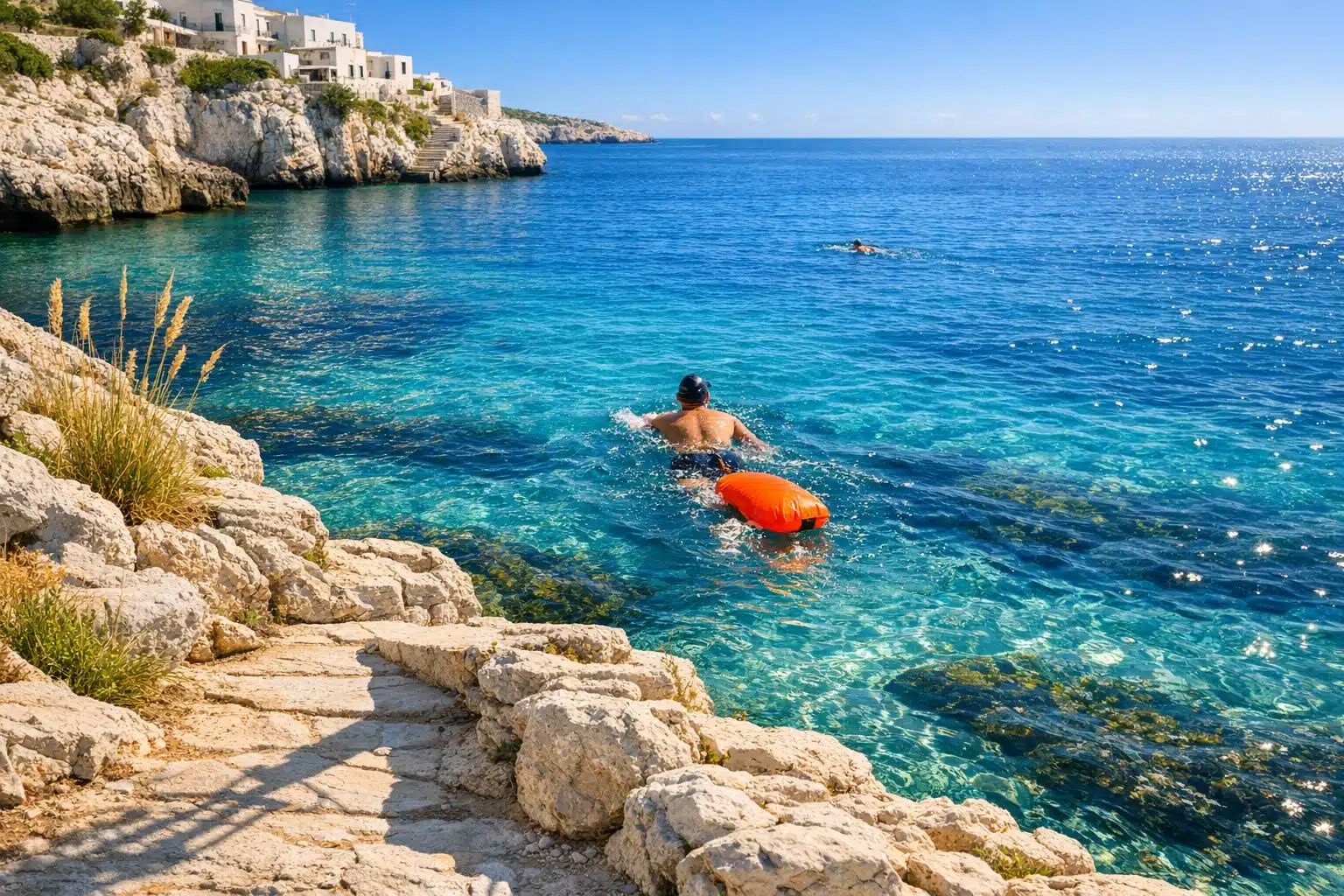
Open water deserves special emphasis. A lake can look calm and still have uneven footing, weeds, sudden cold, or poor visibility. The sea adds surf, tides, and currents that tire swimmers faster than expected. Even experienced pool swimmers are sometimes surprised by how different open water feels without lane lines, walls, or crystal-clear visibility. Swimming with a partner, checking conditions, and using a visible tow float where appropriate are sensible steps, not signs of weakness.
Safety is not the enemy of enjoyment. It is what makes enjoyment sustainable. When a swimmer knows how to rest on the back, control breathing, judge effort, and respect the environment, the water becomes less intimidating and far more rewarding. That is when technique stops feeling like homework and starts feeling like freedom.
Training, Equipment, and Long-Term Progress
One of the best things about swimming is that progress does not require an extreme setup. A pool, some consistency, and a willingness to focus are enough to get started. Still, structured training helps. Many swimmers improve faster when they stop treating every visit as a random collection of laps and begin using sessions with a purpose. A useful swim often includes a warm-up, a skill component, a main set, and an easier finish. That pattern is simple, but it creates direction.
For example, a beginner might swim short repeats with generous rest to keep technique intact, while an intermediate swimmer might use intervals to build endurance. A stronger athlete may include sprint work, pacing sets, or pull and kick segments to target specific weaknesses. The point is not to mimic elite training. The point is to match the session to the swimmer.
Some common tools make practice more effective:
• A kickboard helps isolate kicking, though using it too much can encourage a less natural body position.
• A pull buoy supports the legs so swimmers can focus on arm mechanics and body rotation.
• Fins can improve feel for the water and ankle movement, but they should support drills rather than replace skill.
• Goggles improve comfort and visibility, which matters more than many beginners expect.
• A pace clock or waterproof watch helps turn vague effort into measurable training.
Equipment choices should stay practical. A comfortable swimsuit that allows full movement is more important than fashionable branding. Goggles should seal well without causing headaches. Swim caps help manage hair and reduce drag, but they are not mandatory in every setting. Competitive-style gear can be useful, yet no tool can hide a weak catch, a dropped elbow, or poor breathing rhythm for very long.
Long-term improvement comes from a few repeatable habits: show up consistently, keep technique under review, vary intensity across the week, and measure progress with more than one marker. Pace is one marker, but not the only one. Better breathing control, smoother turns, less fatigue after a session, and improved confidence in deeper water all count as real progress. Swimming is full of quiet victories that never appear on a podium.
For many people, the ideal approach looks like this:
• One session focused on easy aerobic work
• One session with drills and stroke refinement
• One session with intervals or moderate effort
• Optional dry-land strength or mobility on separate days
Stick with that kind of structure, and swimming tends to reward patience. The water does not care about excuses, but it is generous with honest work. Month by month, awkward lengths begin to smooth out, breathing becomes less frantic, and the lane that once felt endless starts to feel familiar.
Conclusion for New, Returning, and Curious Swimmers
If you are new to swimming, the smartest goal is not to look advanced; it is to become calm, safe, and technically sound. If you are returning after a long break, remember that water fitness often comes back in layers, with confidence and rhythm rebuilding alongside endurance. And if you already swim regularly, there is still plenty to explore through better technique, smarter training, or a new setting such as open water.
Swimming remains relevant because it serves so many purposes at once. It can protect, strengthen, challenge, and restore. Few activities can claim that range with equal honesty. Start where you are, respect the learning curve, and let progress come length by length. The world of swimming is wide enough for the cautious beginner, the health-focused adult, and the committed athlete, and each of them can find something meaningful in the water.