Explore the world of swimming
Swimming is one of those rare activities that feels playful on the surface while asking the whole body and mind to work together underneath. It can be a survival skill, a competitive sport, a low-impact workout, and a steady source of calm in the same hour. From crowded public pools to quiet lakes at sunrise, its value reaches far beyond recreation. That blend of usefulness, challenge, and pleasure is exactly why swimming deserves a closer look.
Outline: this article begins with the broader importance of swimming for health, safety, and well-being. It then breaks down the major strokes and explains how they compare in rhythm, efficiency, and difficulty. After that, it looks at training habits, equipment, and essential water safety. The fourth part explores how swimming changes across ages, goals, and settings. The final section brings everything together with practical guidance for readers who want swimming to become part of their routine.
Swimming as a Life Skill, Workout, and Mental Reset
Swimming occupies a special place among physical activities because it solves several needs at once. At the most basic level, it is a life skill. Knowing how to float, breathe calmly, and move through water can increase personal safety in pools, lakes, rivers, and coastal settings. That practical side alone gives swimming a relevance that many other sports do not have. A person may never play a formal match of tennis or run a marathon, yet the ability to stay composed in water can matter at any age.
Its fitness value is equally strong. Swimming engages large muscle groups in the shoulders, back, chest, core, hips, and legs, while also demanding controlled breathing and steady cardiovascular effort. Because water supports body weight, the impact on knees, ankles, and hips is far lower than in many land-based exercises. That makes swimming attractive for people recovering from injury, older adults, and anyone looking for conditioning without constant pounding. Health authorities such as the World Health Organization recommend regular aerobic activity for adults, and swimming can clearly meet that need when done with moderate or vigorous effort.
Another reason swimming stands out is the environment itself. Water creates resistance in every direction, so even smooth, graceful movement requires work. In a gym, resistance often comes from a machine or a weight stack; in a pool, resistance surrounds the body like an invisible training partner. At the same time, the soundscape changes. Noise softens. Breath becomes noticeable. The mind often shifts from scattered thought to immediate awareness: reach, kick, turn, inhale, exhale. For many swimmers, that rhythm feels close to meditation in motion.
Its benefits often include:
• improved aerobic endurance
• greater muscular stamina
• better coordination and posture
• reduced joint stress compared with many impact-heavy activities
• a sense of calm that many people report after a session
Swimming also travels well across lifestyles. A child may begin in lessons, a university student may join a club team, a busy parent may use lap swimming for efficient exercise, and a retiree may turn to aqua fitness or gentle lengths for mobility. Few activities adapt so easily across decades. In that sense, swimming is not merely a sport for specialists. It is more like a language of movement that different people speak in different ways, whether their goal is safety, speed, rehabilitation, or simple enjoyment.
Understanding the Main Strokes and Core Technique
To watch skilled swimmers is to see efficiency made visible. Every unnecessary movement steals momentum, while every well-timed action helps the body slide forward with less effort. The four competitive strokesfreestyle, backstroke, breaststroke, and butterflyeach solve the same challenge in a different way: how to move through water with balance, propulsion, and breath control.
Freestyle, usually swum with a front crawl, is the fastest and most commonly taught stroke for lap swimming. Its alternating arm action and flutter kick create a continuous rhythm that can be adapted for sprinting or endurance work. Because the body remains long and relatively streamlined, freestyle is generally the most efficient stroke for covering distance. Breathing technique matters enormously here. Beginners often lift the head too high, which drops the hips and increases drag. More experienced swimmers rotate slightly, take a quick side breath, and return the face to the water almost immediately.
Backstroke shares the alternating pattern of freestyle, but with the body facing upward. Many new swimmers find breathing easier on the back because the mouth and nose stay clear of the water. Yet backstroke presents its own challenge: direction and body alignment. A relaxed head position and steady hip lift are crucial. Without them, the stroke loses smoothness and turns into a struggle against sinking legs and wandering lines.
Breaststroke is often seen as approachable because the swimmer can keep the face forward more often, but technical mastery is harder than it looks. The pull, breath, kick, and glide must happen in a precise sequence. The whip kick provides much of the propulsion, and timing is everything. When done well, breaststroke feels measured and elegant. When done poorly, it becomes tiring very quickly.
Butterfly is the most demanding of the four strokes. It uses a simultaneous arm recovery and a wave-like body motion powered by the core and dolphin kick. Butterfly is beautiful, dramatic, and unforgiving. It rewards strength and timing but exposes tension and poor mechanics immediately. Even strong athletes often find it exhausting without careful technique.
A useful comparison looks like this:
• Freestyle: fastest, versatile, efficient for distance
• Backstroke: accessible breathing, excellent for posture awareness
• Breaststroke: slower pace, technical timing, popular for recreational swimmers
• Butterfly: highest power demand, advanced coordination, visually striking
Across all strokes, the same principles keep returning: a balanced body position, controlled breathing, efficient kick mechanics, and a stroke pattern that avoids wasted motion. Swimming may appear fluid and free, but its grace is built on detail. A dropped elbow, a late breath, or a poorly timed kick can change the entire feel of a length. That is why even experienced swimmers keep refining fundamentals. In water, small improvements often create surprisingly large results.
Training, Equipment, and Safety in the Water
Good swimming does not come from effort alone. It comes from structured practice, patient repetition, and respect for safety. Many beginners assume that becoming better means simply swimming more lengths, but volume without technique often reinforces bad habits. Effective training usually balances skill drills, endurance work, speed sets, and recovery. Even a short session can be valuable when it has a purpose.
A simple practice might start with an easy warm-up to raise body temperature and loosen the shoulders. Drills can follow, focusing on one idea at a time, such as side breathing in freestyle, streamline off the wall, or timing in breaststroke. The main set may then target stamina or pace, perhaps through repeated distances with brief rest intervals. A cool-down helps bring heart rate down and gives the swimmer a chance to end with relaxed form rather than fatigue-driven flailing. This structure is common from beginner lessons all the way to competitive squads because it works.
Equipment matters too, though not in a flashy way. A comfortable swimsuit, a well-fitting pair of goggles, and a swim cap for those who prefer one are often enough to begin. More specialized tools can support training:
• kickboards isolate leg work
• pull buoys shift emphasis toward the upper body
• fins can help body position and ankle flexibility
• paddles increase feel for the water, though they should be used carefully
• a pace clock or waterproof watch helps track intervals and progress
Still, gear never replaces technique. Expensive equipment cannot fix a rushed stroke or poor breathing pattern. In fact, some tools are best introduced only after a swimmer has basic control, otherwise they may magnify errors. The simplest rule is practical: use equipment to support learning, not to disguise weaknesses.
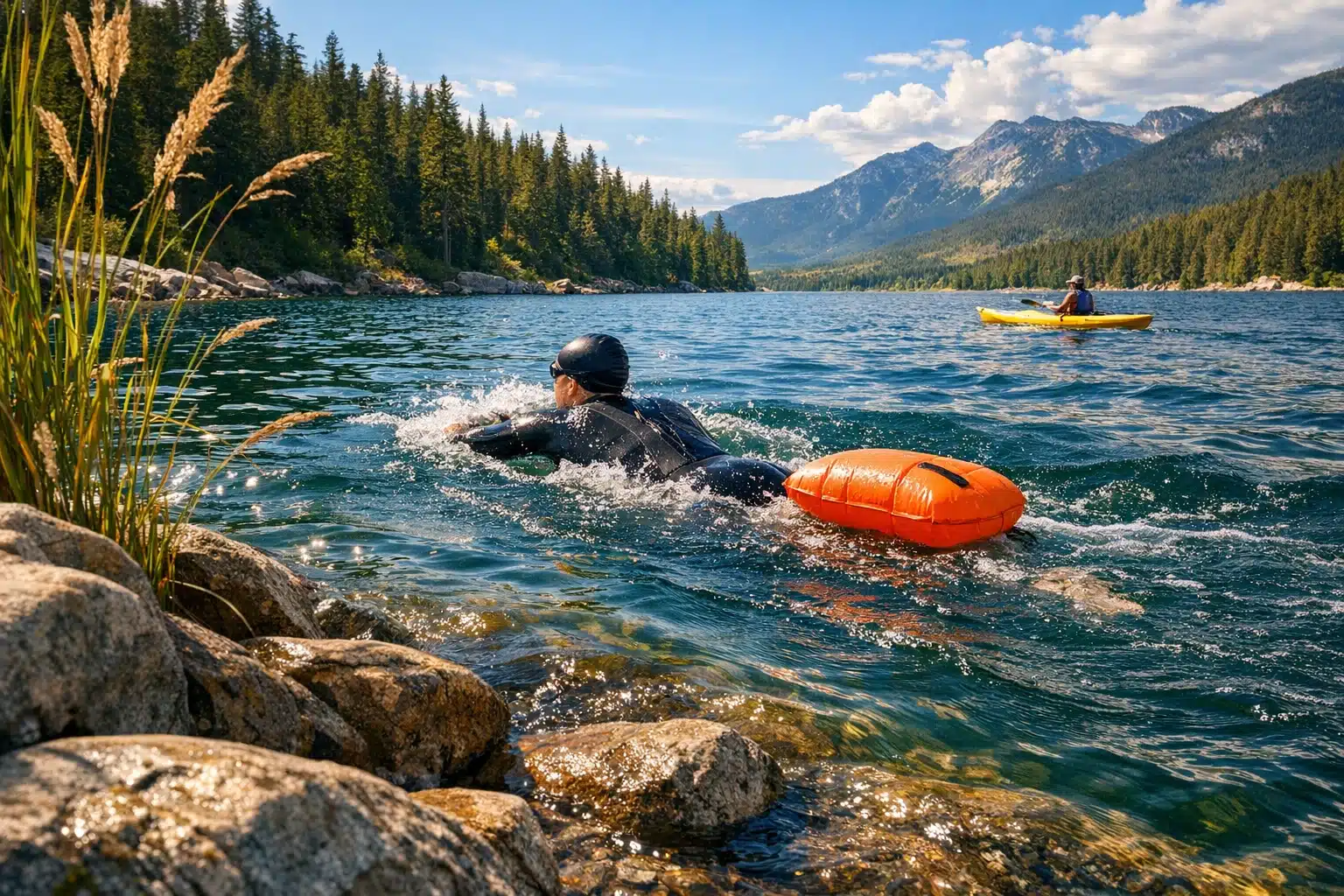
Safety deserves equal attention. In pools, that means understanding lane etiquette, obeying lifeguards, checking depth before diving, and recognizing fatigue early. In open water, the stakes rise. Conditions can change with wind, waves, current, temperature, and visibility. A lake that looks calm from shore may feel completely different once a swimmer is far from land. For that reason, open water swimming should include bright visibility gear, knowledge of the route, and ideally a companion or organized supervision.
There is also the matter of energy management. Overconfidence causes trouble in water more quickly than on land. A person who pushes past exhaustion while running can often stop and stand still; a person who misjudges effort in deep water has fewer options. Smart swimmers know the difference between discomfort and danger. They build capacity gradually, learn to float and rest, and never treat safety skills as something only novices need. In swimming, sound judgment is part of performance.
Swimming for Different Ages, Goals, and Environments
One of swimming’s great strengths is its adaptability. The same medium supports a child’s first splash, an elite athlete’s race preparation, and an older adult’s mobility session. That range is unusual. Many sports narrow as bodies age or needs change, but swimming can widen, offering different forms of challenge at different stages of life.
For children, swimming often begins with comfort in the water rather than stroke perfection. Floating, blowing bubbles, entering and exiting safely, and learning basic movement patterns build confidence that may later support formal technique. Parents often value lessons for obvious safety reasons, yet the developmental benefits also matter. Coordinated movement in water can improve body awareness, listening skills, and confidence. A child who learns to stay calm in water is learning more than mechanics; they are learning how to respond under unfamiliar conditions.
Adults come to swimming for many reasons. Some return after years away because they want exercise that feels sustainable. Others start late and discover that progress is slower than expected, mostly because water punishes tension and rewards patience. Adult learners often benefit from technical instruction more than brute effort. Once body position and breathing improve, swimming usually becomes less intimidating and far more enjoyable. For office workers or people with repetitive joint strain, the pool can feel like a reset button.
Older adults often find swimming especially useful because of its low-impact nature. Water supports movement that may feel difficult on land, which can help maintain mobility, circulation, and confidence in exercise. Aquatic programs are also commonly used in rehabilitation settings, where the goal is controlled motion without heavy loading. In that sense, water becomes a kind of gentle workshop, allowing the body to practice without the harshness of gravity at full force.
The environment shapes the experience as much as age or skill level. Pool swimming is predictable, measured, and ideal for drills, intervals, and technical consistency. Distances are known. Walls provide rest and structure. Open water is another world. It removes lane lines and clock-driven repetition, replacing them with sighting, temperature management, and mental steadiness. Some swimmers find the pool reassuring; others find it monotonous and come alive in lakes or the sea. Neither setting is superior. They simply ask for different habits.
Common swimming goals include:
• learning for safety and confidence
• improving general fitness
• cross-training for another sport
• managing stress through rhythmic movement
• competing in races, triathlons, or masters events
That variety explains swimming’s broad appeal. It does not demand a single identity from participants. You do not need to think of yourself as an athlete to belong in the water. You only need a reason to begin and enough curiosity to keep going.
Conclusion: How to Make Swimming Part of Your Life
If this article is aimed at any one reader, it is the person who suspects swimming might be useful but has not yet decided how it fits into real life. The answer is pleasantly flexible. Swimming can be a weekly fitness habit, a technical hobby, a family safety priority, a rehabilitation tool, or a competitive path. It does not require the same starting point from everyone, and that is part of its charm. A former athlete, a cautious beginner, and a busy parent may all enter the same pool with completely different goals and still find value there.
The most practical way to begin is modestly. Choose access over ideal conditions. A nearby public pool used consistently will usually matter more than a perfect facility visited rarely. Start with manageable sessions. Focus on comfort in the water, relaxed breathing, and clean movement before chasing distance or speed. A lesson or two can save months of frustration because swimming technique is easier to build correctly than to repair later.
For readers who already swim, progress often comes from refinement rather than dramatic change. Better body alignment, quieter kicks, smoother turns, and more thoughtful pacing can transform a session. Improvement in swimming is not always loud. Sometimes it arrives as a length that suddenly feels easier, a breath taken without urgency, or a finish that leaves energy in reserve instead of exhaustion at the wall. Those are meaningful milestones.
Keep these closing ideas in mind:
• learn or revisit water safety, no matter your experience
• build technique before piling on volume
• choose goals that match your age, schedule, and environment
• let consistency do the heavy lifting over time
• remember that enjoyment is not a bonus; it is part of what keeps the habit alive
Swimming has a quiet kind of power. It strengthens without pounding, teaches without preaching, and challenges without always announcing itself. For the reader standing at the edge, wondering whether it is worth the effort, the answer is simple: yes, if you give it time. Step in, learn patiently, and let the water introduce you to a skill that can stay useful for life.