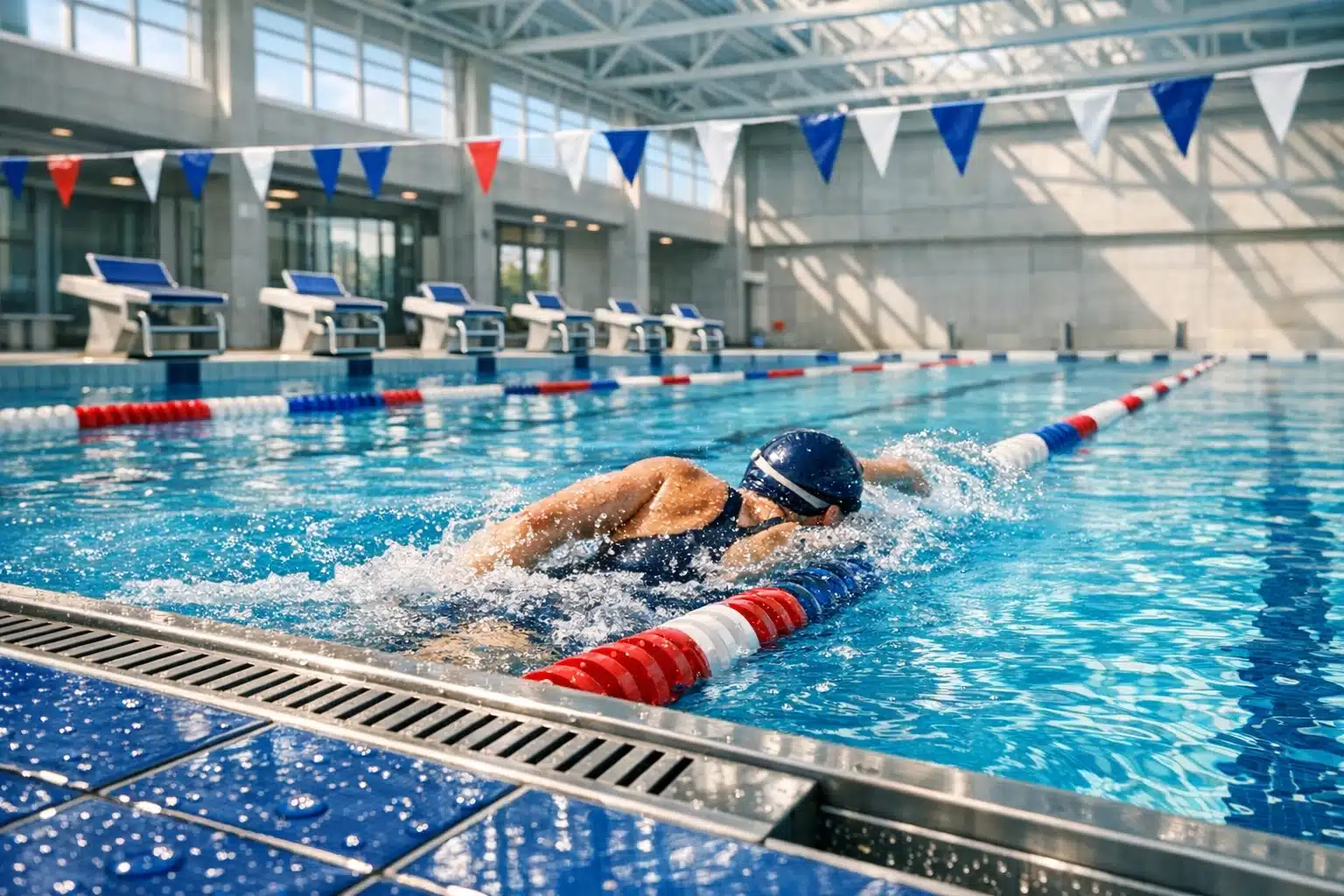
Explore the world of swimming
Swimming sits at the crossroads of sport, survival, therapy, and play, which helps explain its wide appeal. A child learning to float, an adult rebuilding strength after injury, and a competitor chasing tenths of a second all meet the water for different reasons. Few activities train the heart and lungs while easing stress on knees, hips, and back. That unusual balance makes swimming relevant far beyond the pool deck.
Article Outline
- Swimming as a life skill, recreational activity, and competitive sport
- The physical and mental benefits that make it valuable across age groups
- The main strokes, technical fundamentals, and differences in efficiency
- Training habits, equipment choices, and realistic ways to improve
- Water safety principles and a practical conclusion for everyday swimmers
Swimming as a Life Skill, Recreation, and Sport
Swimming is often introduced as a pastime, yet its importance runs much deeper. At its most practical level, it is a safety skill. Knowing how to float, tread water, control breathing, and move calmly toward an exit can reduce panic in an emergency. That alone makes swimming different from many other physical activities. A person can enjoy tennis or cycling without ever needing those skills for survival, but water competency has a direct real-world purpose. This is one reason families, schools, and community centers continue to treat swimming lessons as a meaningful part of childhood development.
Beyond safety, swimming is one of the most flexible forms of recreation available. It can be social or solitary, gentle or intense, playful or highly structured. One swimmer may glide through easy laps before work, another may join a masters group in the evening, while a third simply enjoys moving through cool water on a hot day. The same pool can host infant classes, rehabilitation sessions, school training, and elite competition, which says a lot about the range of the activity. Very few sports can stretch across that many needs without losing their identity.
As a competitive sport, swimming brings precision to the foreground. Races are often decided by fractions of a second, and technique matters enormously. In track events, raw power can sometimes cover technical flaws. In water, inefficiency is punished quickly because every misplaced movement creates drag. Competitive swimmers learn this early. A dropped elbow, mistimed breath, or rushed turn can waste energy and time in ways that are surprisingly visible on the clock. That technical nature is part of swimming’s appeal. It rewards discipline, repeatable habits, and patient refinement rather than noise or spectacle.
Swimming also compares favorably with many land-based activities in terms of lifelong access. Contact sports can become less practical as people age, and high-impact exercise may become uncomfortable for some bodies. Swimming, by contrast, often remains viable for children, adults, older people, and those returning from injury. Aquatic exercise classes, lane swimming, and gentle mobility work all show how adaptable the medium can be. In the pool, gravity loosens its grip a little, and movement becomes available to people who might struggle elsewhere.
This combination of usefulness, enjoyment, and adaptability helps explain why swimming has such staying power. It teaches confidence, invites curiosity, and offers a measurable path for growth. Whether someone is learning to put their face in the water for the first time or racing in a 50-meter pool under bright lights, swimming remains the same essential conversation between body, breath, and buoyancy.
How Swimming Benefits the Body and Mind
Swimming is frequently praised as a full-body workout, and that description is deserved. Water is roughly 800 times denser than air, so even simple movements meet steady resistance. Unlike some gym exercises that isolate one area at a time, swimming asks the shoulders, back, chest, core, hips, and legs to coordinate continuously. Front crawl relies on rotation and rhythm, breaststroke demands timing and mobility, backstroke challenges body alignment, and butterfly calls for whole-body power. Because resistance comes from the surrounding water rather than heavy external loads, the effort feels smooth even when it is demanding.
Cardiovascular benefits are a major reason many people choose swimming. Public health guidelines commonly recommend at least 150 minutes of moderate aerobic activity each week for adults, and lap swimming can contribute meaningfully toward that goal. Depending on body size, stroke choice, and pace, an hour of steady to vigorous swimming may burn roughly 400 to 700 calories. The exact number varies, but the broader point holds: swimming can raise the heart rate, improve endurance, and support weight management when practiced consistently. Some swimmers also notice that the cooling effect of water makes sustained exercise feel more manageable than hard training on land.
The low-impact nature of swimming is another advantage. Runners, for instance, may benefit from excellent cardiovascular training, but repetitive impact can irritate joints in some people. Swimming removes much of that pounding. This makes it attractive for older adults, people with joint discomfort, and those easing back into exercise after time away. Rehabilitation settings often use aquatic movement because buoyancy can reduce load while still allowing meaningful muscular work. In chest-deep water, the body carries far less effective weight than it does on land, which can make motion more comfortable and confidence easier to rebuild.
Mental benefits are just as important, even if they are harder to measure with a stopwatch. Repetitive strokes and rhythmic breathing can create a focused, almost meditative state. For some people, a swim session provides relief from digital noise, crowded schedules, or anxious thinking. The pool has a way of narrowing attention to essentials: inhale, exhale, reach, kick, turn, continue. That simplicity can be deeply restorative. Group swimming adds another layer through community, routine, and shared progress.
Some of swimming’s most recognized advantages include:
- Low-impact aerobic conditioning
- Strength and coordination across multiple muscle groups
- Improved breath control and pacing awareness
- A practical option for cross-training and recovery
- Mental refreshment through rhythmic, immersive movement
No activity solves every fitness problem, and swimming has limits. It may not build bone density as effectively as weight-bearing exercise, and access to pools can be a barrier. Even so, its blend of endurance, coordination, and joint-friendly resistance makes it one of the most balanced physical activities available. For many people, it is not merely exercise. It is a sustainable way to feel more capable in their own bodies.
Understanding Strokes, Technique, and Efficiency
Swimming looks simple from the deck, but technique quickly reveals its depth. The four main competitive strokes are front crawl, backstroke, breaststroke, and butterfly, and each has its own rhythm, mechanics, and purpose. Front crawl, often called freestyle in casual conversation, is typically the fastest and most efficient stroke for covering distance. Its alternating arm action, flutter kick, and streamlined body position allow strong forward momentum. Backstroke uses similar rotational mechanics but places the swimmer face-up, which changes breathing demands and directional awareness. Breaststroke is usually slower, yet many beginners find its breathing pattern more approachable because the head rises naturally during each cycle. Butterfly is the most powerful and technically demanding, combining simultaneous arm recovery with a dolphin kick that requires timing, mobility, and strength.
What separates effective swimming from tiring splashing is efficiency. In water, small technical choices matter because drag steals speed relentlessly. A runner can sometimes push through messy form for a short distance. A swimmer who fights the water pays for it stroke after stroke. Good technique begins with body position. The straighter and more balanced the body is, the less resistance it creates. Head placement, hip height, and a stable core all influence whether the swimmer moves cleanly or feels like they are towing an invisible anchor.
Breathing is another decisive element. Beginners often hold tension in the neck and shoulders, lift the head too high, or breathe too late in the stroke. That disrupts alignment and can make the legs sink. Skilled swimmers treat breathing as part of the stroke rather than a break from it. In front crawl, for example, the head turns with the body’s rotation instead of lifting independently. The goal is not dramatic air but quick, calm exchange. Exhale in the water, inhale efficiently, and return to position without delay.
Key technical priorities usually include:
- Maintaining a long, balanced body line
- Learning controlled exhalation underwater
- Using the kick to support position, not merely to create turbulence
- Catching water effectively with the hands and forearms
- Turning smoothly at the wall to preserve rhythm
Comparing strokes also helps swimmers choose what suits their goals. A person seeking speed and conditioning may focus on front crawl. Someone recovering mobility may prefer breaststroke in moderation, though its kick can bother certain knees if done poorly. Backstroke can be excellent for posture awareness and shoulder coordination, provided technique is sound. Butterfly, while less practical for casual distance work, teaches body timing and power transfer in a vivid way. Each stroke is like a different dialect in the language of water.
Improvement often comes less from doing more laps and more from doing smarter laps. Drills such as side kicking, catch-up swimming, single-arm work, or sculling can sharpen awareness far better than mindless repetition. Coaches emphasize this because technique compounds over time. A modest gain in efficiency may save significant energy over dozens of lengths. In that sense, swimming is part science, part craft. The water gives immediate feedback, and it rarely flatters. When form improves, the reward is unmistakable: the same pool suddenly feels shorter.
Training, Equipment, and Building a Sustainable Routine
A successful swimming routine does not begin with heroic ambition. It begins with realism. Many people return to the pool after years away and assume they should be able to swim continuously for long distances. Water is humbling enough to correct that idea quickly. A smarter approach is to build volume gradually, mix easy and moderate efforts, and respect how technical fatigue can appear before muscular exhaustion. Ten well-focused lengths can be more valuable than thirty disorganized ones. In swimming, quality and consistency almost always outrun bursts of enthusiasm.
Beginners often benefit from interval-based sessions rather than nonstop laps. For example, a swimmer might complete 8 x 25 meters with generous rest, then progress to 6 x 50 meters, and later to longer repeats as comfort grows. This structure makes technique easier to preserve. Intermediate swimmers may use sets such as 10 x 100 meters at a steady pace with short recovery, while competitive athletes blend aerobic work, sprinting, kick sets, drills, and pace-specific training across the week. The exact program varies, but the principle is stable: improvement comes from repeated, manageable stress followed by adaptation.
Equipment can help, provided it supports rather than replaces skill. Good goggles are the most essential item for most swimmers because comfort and visibility matter immediately. A swim cap is practical for reducing drag slightly and keeping hair contained. Kickboards can isolate leg work, pull buoys shift focus toward the upper body, and fins may help body position or drill practice when used thoughtfully. Paddles increase resistance and can strengthen the pull, though they are best introduced carefully to avoid shoulder strain. For open-water swimmers, brightly colored caps and tow floats add visibility and peace of mind.
A useful routine may include:
- One session focused on easy endurance and relaxed technique
- One session built around drills and breathing control
- One session with moderate intervals for aerobic fitness
- Optional dryland work for mobility, posture, and shoulder stability
- Rest days that allow recovery instead of guilt
Tracking progress also helps. Swimmers can note distance, time, perceived effort, stroke count, or how many breaths it takes to settle into rhythm. Unlike step-based activities, swimming improvement is not always obvious from the outside. A small drop in pace per 100 meters, a cleaner turn, or an easier exhalation pattern may signal meaningful progress. Some swimmers use waterproof watches, while others simply remember a set that once felt impossible and now feels ordinary.
Comparisons with other sports are useful here. In running, beginners can often measure progress through mileage. In strength training, weight on the bar provides a clear marker. Swimming hides its gains under the surface. Better balance, reduced drag, and improved timing are not always dramatic to observe, but they change the experience profoundly. That is why sustainable training matters. A routine that fits real life, respects recovery, and leaves room for enjoyment has far better odds than an exhausting plan abandoned after two weeks. Swimming rewards the patient. The water keeps score, but it does not rush the lesson.
Water Safety and Conclusion for New and Returning Swimmers
Swimming becomes far more enjoyable when safety is treated as part of skill rather than an afterthought. Pool water may look calm, and open water may look inviting, yet both environments demand judgment. Beginners should learn with supervision whenever possible, ideally from qualified instructors or in settings with trained lifeguards. Even confident swimmers benefit from simple habits: entering unknown water carefully, checking depth, respecting lane rules, and avoiding horseplay that can trigger panic. Confidence in water is valuable, but overconfidence has spoiled many otherwise sensible days.
Open water introduces additional variables that pools cannot fully simulate. Temperature, wind, currents, waves, visibility, and changing bottoms all affect risk. A lake can feel peaceful from shore and still become disorienting once a swimmer loses familiar visual references. The sea adds tides and rip currents, which require specific knowledge. Wearing a bright cap, swimming with a partner, telling someone your route, and using a flotation buoy are practical choices rather than signs of weakness. In fact, experienced open-water swimmers often look the most cautious because they understand how quickly conditions can shift.
Parents and caregivers have a special role in water safety. Lessons matter, but supervision matters just as much. A child who can swim a short distance is not automatically safe around water. Pools need barriers, rules need consistency, and adults need to watch actively rather than casually. Phones, conversations, and assumptions are poor lifeguards. The same principle applies at social gatherings where many people may assume someone else is paying attention. Clear responsibility prevents dangerous gaps.
Helpful safety habits include:
- Learning floating, treading water, and safe breathing before chasing speed
- Choosing supervised locations whenever possible
- Understanding weather, currents, and temperature in open water
- Using appropriate gear such as life jackets for boating or inexperienced swimmers
- Stopping early if fatigue, cramps, or disorientation appear
For the target audience of this article, especially beginners, returning adults, and fitness-minded readers, the most encouraging truth is that swimming does not demand a single identity. You do not need to be a racer to benefit from lap sessions, and you do not need perfect technique to begin learning well. Progress can start with floating comfortably, exhaling underwater, or finishing a short set without tension. Those are not tiny wins. They are the foundation of everything that follows.
In conclusion, swimming is worth pursuing because it joins practicality with pleasure. It can teach safety, improve cardiovascular fitness, protect stressed joints, sharpen concentration, and open a path toward lifelong activity. Start where you are, learn patiently, and let skill grow one length at a time. The pool does not ask for perfection on day one; it simply asks you to meet the water with attention, respect, and a willingness to return.