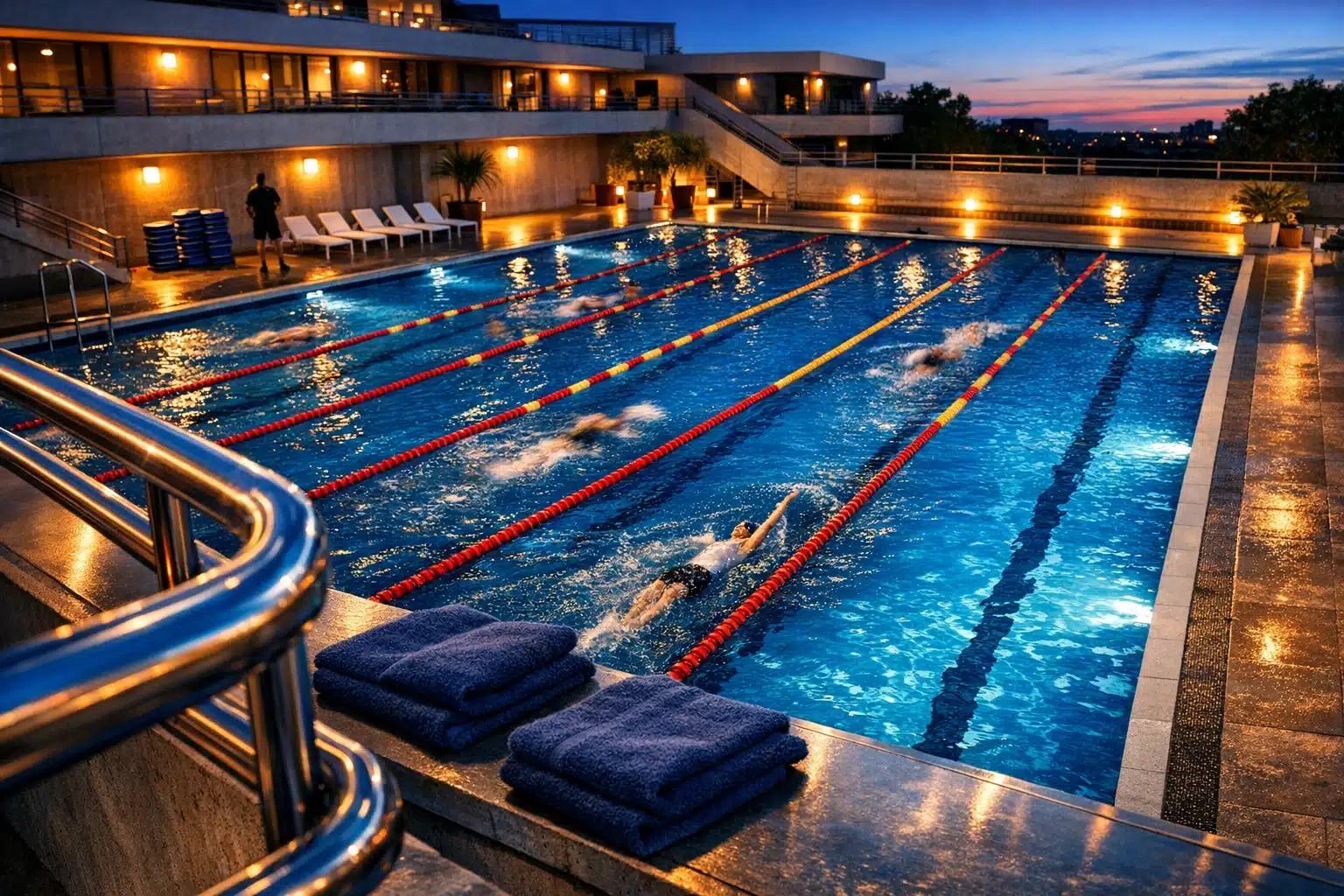
Explore the world of swimming
Swimming sits at the crossroads of sport, survival, and simple pleasure, which is why it remains relevant in nearly every stage of life. A child may discover confidence in the shallow end, an athlete may chase tenths of a second in a race, and an older adult may find graceful movement that is kind to the joints. Across health, recreation, and performance, the water creates a rare setting where technique, safety, endurance, and joy meet.
Outline
- Swimming in context: where it came from, how it developed, and why it still matters.
- The physical and mental benefits of swimming, with comparisons to other common forms of exercise.
- The four main strokes and how their techniques, strengths, and challenges differ.
- Water safety, learning progression, and smart training habits for beginners and experienced swimmers.
- Swimming as a lifelong practice through competition, community, accessibility, and practical next steps.
Swimming in Context: Origins, Forms, and Lasting Appeal
Swimming is one of humanity’s oldest physical skills, yet it somehow always feels fresh. Long before lane ropes, pace clocks, or Olympic finals, people swam to cross rivers, fish, travel, train for war, and stay alive. Historical evidence from ancient Egypt, Greece, Rome, India, and Japan shows that swimming was known and practiced widely, though not always in the same style or for the same reasons. In the modern era, the activity moved from necessity into organized recreation and competition. The nineteenth century saw clubs, formal races, and the gradual standardization of strokes. By the time swimming became a major Olympic sport, it had already developed a dual identity: practical and poetic, disciplined and liberating.
Part of swimming’s appeal lies in its flexibility. Few activities serve so many purposes at once. A person can swim for fun on holiday, train seriously for a meet, recover from injury, teach a child an essential safety skill, or join a masters program decades after leaving school sports behind. The pool is one version of the story, but not the only one. Swimming also belongs to lakes, rivers, oceans, quarry waters, and community centers. Each setting changes the experience. A pool is measured, predictable, and technical. Open water feels more like a conversation with nature: waves interrupt rhythm, sighting replaces line-following, and temperature becomes part of the challenge.
It is also useful to distinguish among the main forms of swimming people encounter:
-
Recreational swimming, centered on enjoyment, comfort, and basic movement in water.
-
Learn-to-swim instruction, focused on safety, breathing control, floating, propulsion, and confidence.
-
Fitness swimming, where lap work builds endurance, strength, and cardiovascular health.
-
Competitive swimming, organized around strokes, starts, turns, pacing, and race strategy.
-
Open water swimming, which introduces navigation, weather, and environmental awareness.
Swimming endures because it offers something many sports cannot: the sense that skill and sensation matter as much as outcome. On land, effort often feels loud. In water, even hard work can seem quiet. The body becomes both engine and vessel. That quality helps explain why swimming attracts schoolchildren, elite athletes, rehabilitating patients, and people who simply need one hour in a blue rectangle to reset the day.
Why Swimming Works So Well for Body and Mind
Swimming is often praised as a “full-body workout,” and in this case the phrase is not empty marketing. Water creates resistance in every direction, so nearly every movement demands coordinated effort. The shoulders guide entry and pull, the back stabilizes posture, the core keeps the body aligned, and the legs drive propulsion or maintain balance depending on the stroke. Because water is far denser than air, even smooth movement requires sustained muscular engagement. At the same time, buoyancy reduces the impact placed on joints, which makes swimming especially valuable for people who find running or high-impact aerobics uncomfortable.
From a cardiovascular perspective, swimming can be remarkably effective. Steady lap swimming challenges the heart and lungs, while interval training increases intensity and helps improve speed and aerobic capacity. The exact energy cost varies by stroke, body size, pace, and water temperature, but moderate to vigorous swimming can burn several hundred calories per hour. Butterfly and fast front crawl generally demand more energy than gentle breaststroke or easy backstroke. That range is useful because it allows swimmers to adapt training to different goals, whether those goals involve general fitness, endurance, body composition, or race preparation.
Compared with other popular forms of exercise, swimming has clear strengths and a few trade-offs:
-
Compared with running, it is usually kinder to knees, hips, and ankles.
-
Compared with cycling, it often requires more whole-body coordination rather than lower-body emphasis.
-
Compared with strength training, it builds muscular endurance more than maximal force, unless combined with dryland work.
-
Compared with walking, it can produce a stronger cardiovascular challenge in a shorter session, depending on pace.
The mental benefits deserve equal attention. Many swimmers describe a session as both stimulating and calming, which sounds contradictory until you try it. Repetitive strokes, controlled breathing, and the muffled acoustics of water create a rhythm that can reduce stress and sharpen focus. The mind stops scattering and starts counting laps, noticing hand position, or syncing exhalation with movement. For some, that rhythm feels meditative; for others, it simply provides relief from screens, noise, and clutter. There is also the confidence factor. Learning to move well in water often changes how people think about challenge more broadly. The first unassisted length, the first deep-water tread, or the first open-water swim can feel like small private revolutions.
Swimming is not perfect for every goal. Someone seeking maximum bone-loading stimulus may benefit more from weight-bearing exercise, and a beginner with poor technique may struggle to sustain intensity. Still, as a blend of fitness, joint-friendly movement, breath control, and psychological reset, swimming remains one of the most balanced activities available.
Understanding the Four Main Strokes
To watch a strong swimmer change strokes is to see four different languages spoken by the same body. Competitive swimming is built around freestyle, backstroke, breaststroke, and butterfly, and each stroke asks for its own timing, posture, and problem-solving. Learning these differences is useful even for casual swimmers because stroke choice affects effort, comfort, speed, and technique development.
Freestyle, usually swum as front crawl, is the fastest and most efficient stroke for most people. The swimmer stays horizontal, rotates through the torso, recovers one arm over the water while the other pulls underneath, and uses flutter kick to maintain momentum. Breathing to the side must fit naturally into the body roll, which is why beginners often struggle with it at first. Once the timing clicks, freestyle becomes the main tool for fitness swimming because it rewards efficiency and supports a wide range of training intensities.
Backstroke mirrors some freestyle mechanics but turns the swimmer face-up. That position makes breathing easier because the mouth is clear of the water, but it introduces new challenges, especially body alignment and straight-line swimming. Many learners enjoy backstroke because it feels less claustrophobic than face-down swimming. It also encourages balance and awareness of hip position. In races, swimmers start in the water and rely on ceiling markers or stroke counts to judge the wall.
Breaststroke is often the most recognizable stroke among non-competitive swimmers, but good breaststroke is more technical than it appears. The pull, breath, kick, and glide must occur in a precise sequence. The whip kick is distinct, and poor timing can create drag very quickly. Breaststroke is slower than freestyle for most swimmers, yet it can feel sustainable and controlled. Because the head rises naturally during the stroke cycle, many people find it approachable, though over-lifting the head can strain the neck and hips.
Butterfly is the most demanding of the four and, when performed well, the most dramatic. Both arms recover together over the water, the body moves in a wave-like undulation, and the dolphin kick drives rhythm from the core through the legs. It is beautiful, brutal, and deeply unforgiving of sloppy timing. Butterfly requires power, mobility, and coordination, which is why coaches usually introduce it after swimmers have built strong foundations in other strokes.
-
Fastest for most swimmers: freestyle
-
Most relaxed breathing position: backstroke
-
Most timing-dependent at slower speeds: breaststroke
-
Most physically demanding: butterfly
Stroke choice also shapes training. Freestyle dominates distance work, backstroke supports posture and variety, breaststroke refines timing, and butterfly develops rhythm and strength. Even if a swimmer never enters a race, understanding the four strokes makes pool time richer. It turns swimming from simple movement into skilled movement, and that difference is where progress begins.
Learning, Safety, and Smart Training Habits
Swimming is joyful, but water does not negotiate. That is why safety is not a side note; it is the frame around everything else. According to global public health authorities such as the World Health Organization, drowning remains a major cause of unintentional injury death worldwide, particularly among children. This fact alone explains why learning to swim should be treated as a basic life skill rather than a luxury hobby. Confidence in water is valuable, but confidence without judgment can become dangerous very quickly.
For beginners, progress works best in a clear sequence. First comes comfort in the water: entering safely, submerging the face, blowing bubbles, and standing or holding the wall calmly. Next comes floating and balance, because a tense swimmer sinks effort into panic rather than movement. Then come propulsion skills such as kicking, arm action, and coordinated breathing. Only after these pieces start fitting together does longer-distance swimming become productive. Skipping the foundation phase often leads to bad habits, fatigue, and fear.
Good instruction matters. A qualified coach or teacher can correct body position in minutes where self-teaching might produce weeks of frustration. Small adjustments make a huge difference, such as relaxing the neck during freestyle, engaging the hips during kicking, or exhaling steadily underwater instead of holding the breath. Many adult beginners assume they are “bad swimmers” when the real problem is inefficient technique rather than lack of effort.
Smart safety habits apply to everyone, not just newcomers:
-
Swim where supervision is available whenever possible, especially for children and inexperienced swimmers.
-
Respect local conditions in open water, including currents, temperature, visibility, and boat traffic.
-
Use the buddy system instead of swimming alone in unfamiliar places.
-
Warm up gradually; cold water can alter breathing and muscle control.
-
Learn basic rescue awareness and avoid jumping in impulsively without training.
Training itself should be structured but adaptable. A simple session may include a warm-up, a drill set, a main endurance or speed set, and an easy cooldown. Drills are especially important because swimming rewards precision. Unlike some land exercises where brute effort can carry a person surprisingly far, poor mechanics in the water usually create drag, and drag is expensive. A swimmer who improves streamline, catch, and kick timing can become noticeably faster without becoming significantly stronger.
Equipment can help when used correctly. Goggles improve comfort and vision. Kickboards isolate the legs, pull buoys emphasize upper-body work, and fins can reinforce body position and ankle flexibility. Still, tools should support technique, not replace it. The best training habit is consistent, attentive practice. In swimming, meters matter, but awareness matters more.
Swimming as a Lifelong Practice: Community, Competition, and a Practical Conclusion
Swimming does not end at the edge of a lesson plan or the finish of a race. For many people, it becomes a long-term practice that shifts shape over time. A teenager may compete in school, step away in adulthood, and return years later for fitness, rehab, or peace of mind. Another swimmer may begin with fear, move into confidence, and eventually discover open water, triathlon, or masters competition. This adaptability is one of the sport’s great strengths. It does not demand that every participant want the same thing.
The competitive side of swimming offers a structured path for those who enjoy measurable progress. Times, splits, stroke counts, turns, and starts provide constant feedback. There is something uniquely honest about the clock in swimming; it does not flatter and it does not argue. Yet even competition varies widely. Local club meets focus on development and experience. Collegiate and national racing demand higher training volumes and tactical precision. At the top end, Olympic and world-level swimming becomes a study in detail, where fractions of a second are shaped by reaction time, underwater efficiency, and stroke economy.
Community matters just as much as competition. Pools are social places even when swimmers spend much of the hour moving silently down a lane. People share space, routines, encouragement, and small rituals. The early-morning lap crowd, the learn-to-swim families, the rehab group, the masters squad, and the open-water regulars all form their own subcultures. In many places, swimming also supports inclusion through adaptive programs and para-swimming opportunities, proving that skill in water can be developed across a wide range of bodies and abilities.
There are also practical challenges worth acknowledging. Access is uneven. Not every area has affordable pools, safe open water, or quality instruction. Maintenance costs, seasonal closures, and limited public facilities can make swimming harder to pursue than walking or home exercise. Even so, when access exists, the return can be substantial. Few activities combine safety education, fitness, stress relief, and recreational value in such a compact package.
For readers wondering where to begin, the most effective approach is simple:
-
Start with comfort and safety before chasing distance.
-
Choose one or two realistic weekly sessions and build consistency.
-
Focus on technique early, because easy efficiency beats frantic effort.
-
Use goals that fit your life, whether that means ten calm lengths or a future open-water event.
In the end, swimming offers more than exercise. It teaches control without rigidity, effort without noise, and progress measured not only by speed but by ease. For beginners, it opens the door to safety and confidence. For regular exercisers, it adds a powerful and joint-friendly training option. For lifelong learners, it provides a rare skill that remains useful, challenging, and quietly rewarding no matter when you return to the water.