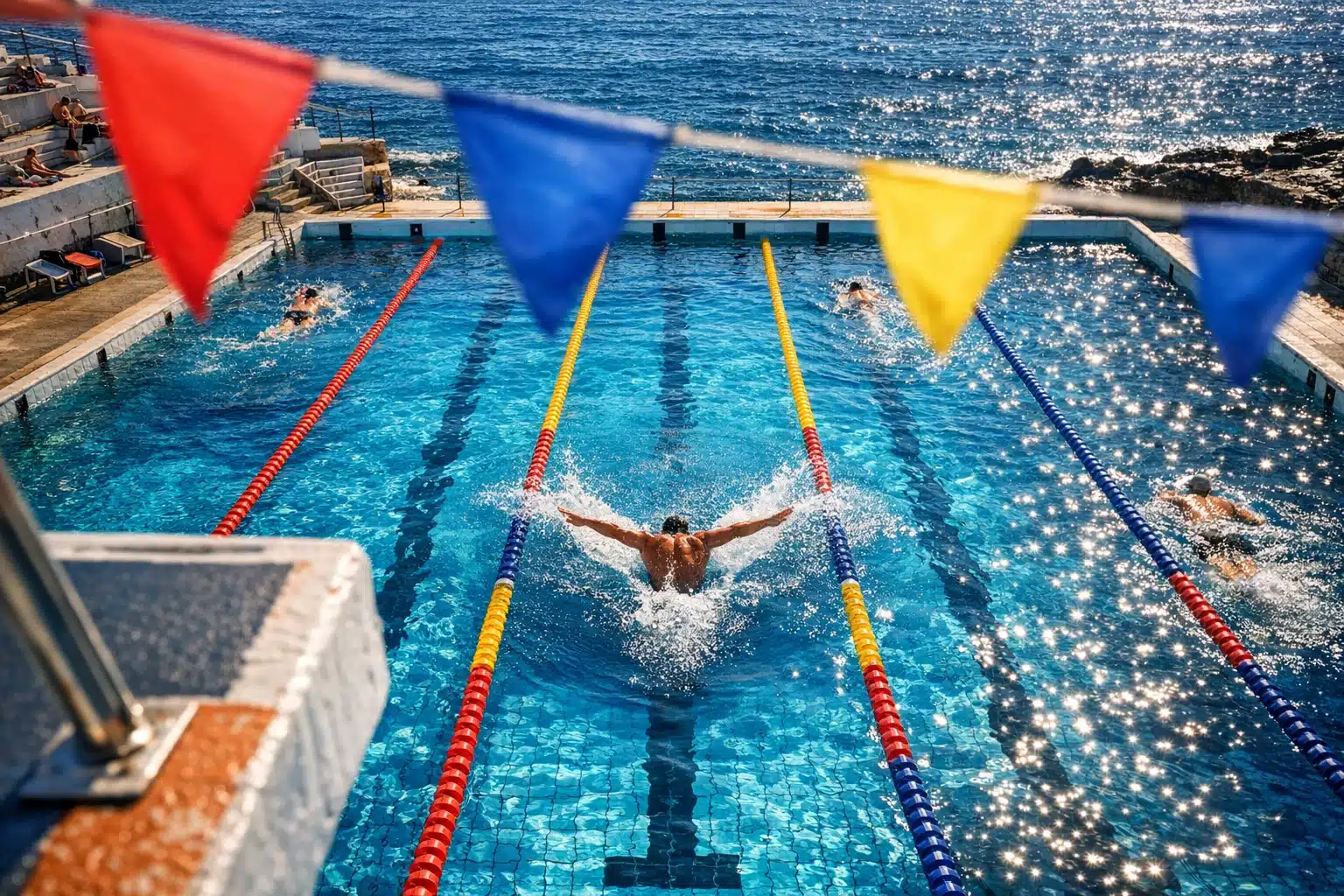
Explore the world of swimming
Swimming sits at a rare crossroads where play, survival, sport, and lifelong fitness meet in the same lane. It asks the body to move through water, a medium far denser than air, while rewarding effort with low-impact conditioning that suits children, adults, and many older learners. From beach holidays to elite competition, its relevance stretches across health, safety, recreation, and culture. This article explores the essentials so readers can understand why swimming remains one of the most practical and compelling activities on the planet.
Outline: 1) the physical and health foundations that make swimming unique, 2) the major strokes and how they differ in technique and purpose, 3) practical ways to learn, train, and choose equipment, 4) the environments, safety principles, and everyday uses of swimming, and 5) a conclusion aimed at readers who want to turn interest into a lasting habit.
The Foundations of Swimming: Why Water Changes Everything
Swimming is often described as a full-body activity, but that phrase only hints at what makes it so distinctive. On land, movement is shaped by gravity, friction, and impact. In water, the rules feel different. Buoyancy supports body weight, resistance comes from every direction, and breathing must be timed instead of taken for granted. Those three changes make swimming both demanding and forgiving: demanding because water pushes back against every stroke, and forgiving because joints usually experience less pounding than they would during running or jumping. That combination explains why swimming appeals to such a wide range of people, from children in their first lessons to adults recovering fitness after years away from exercise.
Water is significantly denser than air, which means even simple movements require controlled effort. A short swim can challenge the shoulders, back, core, hips, and legs all at once. At the same time, the horizontal body position can reduce stress on knees and ankles, which is one reason swimming is regularly recommended as a lower-impact option for people who want cardiovascular work without constant pounding. It is not effortless, of course. Anyone who has tried to swim one relaxed lap and emerged breathing hard knows that water has a quiet way of exposing inefficiency. Technique matters, and that is part of the sport’s charm: progress often comes not from muscling through the pool, but from learning how to move with cleaner timing and less waste.
The health relevance of swimming is broad. Regular swimming can support heart and lung function, muscular endurance, mobility, and general fitness. Public health guidance in many countries recommends at least 150 minutes of moderate aerobic activity per week for adults, and swimming can help meet that target. Energy expenditure varies widely depending on stroke, pace, body size, and conditioning, but a vigorous session can be demanding enough to rival many land-based workouts. Beyond fitness, swimming also builds a practical life skill. Knowing how to float, tread water, and move calmly in water is not just recreational knowledge; it can contribute to safety around pools, lakes, rivers, and coastlines.
What makes swimming stand out for many readers is its unusual blend of outcomes:
• it can improve endurance without heavy impact
• it develops coordination because breathing and movement must sync
• it offers recreation as well as structured training
• it teaches water confidence that can matter outside sport
There is also a mental side worth noting. The soundscape of a pool is strangely memorable: splashes, echoes, the rhythmic exhale into water, and the soft interruption of a turn at the wall. For some people, that rhythm becomes meditative. For others, it becomes competitive fuel. Either way, swimming gives back what the swimmer brings to it. It can be playful, technical, calming, social, or intense, often within the same hour. That range is a major reason it remains relevant in schools, community programs, rehabilitation settings, family life, and international sport.
Understanding the Main Strokes and the Mechanics Behind Them
To an observer standing on deck, swimming strokes may look like variations on a simple idea: move the arms, kick the legs, breathe, repeat. In practice, each stroke has its own logic, rhythm, and purpose. The four main competitive strokes are freestyle, backstroke, breaststroke, and butterfly. Each demands a distinct relationship between balance, propulsion, drag, and breathing. Learning the differences helps swimmers train more intelligently and appreciate why one stroke feels smooth while another feels like a negotiation with the water.
Freestyle, usually swum with the front crawl, is the fastest and most common stroke in fitness swimming. The body stays long and streamlined, the arms alternate in a windmill-like pattern, and the legs use a flutter kick. Breathing happens to the side, ideally without lifting the head too high. For beginners, freestyle often becomes the entry point because it is efficient once learned, yet it can feel awkward at first. The biggest challenges are usually body position and breath timing. If the hips sink or the head lifts, drag increases quickly. A small technical fix can make a large difference, which is why coaching cues such as “look down,” “reach forward,” and “rotate through the torso” are repeated so often.
Backstroke shares some features with freestyle, including an alternating arm action and flutter kick, but the swimmer lies on the back with the face above water. That changes the breathing demands and often makes the stroke less intimidating for people who dislike side breathing. Still, it introduces a different puzzle: orientation. Swimming in a straight line without seeing the direction of travel takes practice. Backstroke can feel liberating, almost like gliding beneath the ceiling instead of chasing the black line on the pool floor, but it still requires strong body alignment and a steady kick.
Breaststroke is slower than freestyle and backstroke for most swimmers, yet it is often one of the first strokes people recognize. The arm pull and leg kick happen in a more symmetrical pattern, and the swimmer typically lifts the head forward to breathe during each cycle. Because the timing is different, breaststroke can feel more intuitive to casual swimmers. However, efficient breaststroke is highly technical. A powerful whip kick, controlled glide, and well-timed pull are essential. Done poorly, it becomes tiring and choppy. Done well, it looks economical, almost deliberate in its patience.
Butterfly is the most physically demanding stroke for many people. Both arms recover over the water together, the body undulates, and the legs perform a dolphin kick. It rewards timing, strength, and rhythm more than brute force alone. To a new swimmer, butterfly can seem dramatic and slightly mythical, like a stroke invented to prove that grace and suffering can coexist. Yet even basic butterfly drills can teach excellent body awareness.
A simple comparison is useful:
• freestyle is usually the fastest and most efficient for distance
• backstroke offers easier breathing but requires spatial awareness
• breaststroke is accessible in appearance but technically precise
• butterfly is powerful, advanced, and rhythm-dependent
Across all strokes, the same fundamentals keep returning: streamline the body, reduce drag, generate propulsion cleanly, and breathe without breaking balance. Those principles explain why a skilled swimmer can look calm at high speed while an inexperienced swimmer works much harder for less distance. In swimming, the water always tells the truth about technique.
Learning to Swim and Training Well: From First Lesson to Structured Practice
Learning to swim is not a single leap from fear to fluency. It is usually a sequence of manageable steps: becoming comfortable in the water, learning to float, exhale underwater, kick with control, coordinate arm actions, and eventually combine those skills into full strokes. For children, this progression often unfolds through games and repetition. For adults, it may require unlearning tension first. Many adult beginners are not limited by strength; they are limited by uncertainty. Water magnifies hesitation. A stiff neck, clenched jaw, or rushed breath can turn a simple drill into a struggle. Good instruction works by shrinking that struggle into small wins.
The earliest building blocks matter more than people think. Floating teaches trust in buoyancy. Blowing bubbles teaches breath control. Pushing off the wall teaches streamline. Kicking drills teach balance and propulsion without overloading the brain with too many moving parts at once. These early exercises may look simple from the deck, but they form the architecture of later skill. A swimmer who learns calm exhalation and balanced body position often progresses faster than someone who tries to muscle through full laps immediately.
For readers who are already comfortable in the water, training introduces a new layer of purpose. A swim session is not just “doing lengths.” It can include a warm-up, drills, main sets, recovery work, and cooldown, much like a structured run or bike workout. Intervals are common because they let swimmers combine technique and conditioning. For example, short repeats with rest can improve speed and form, while longer continuous swims can develop aerobic endurance. The pool becomes a laboratory where effort, timing, and mechanics can be adjusted with unusual precision.
Basic equipment also plays a supporting role. Swimmers do not need a mountain of gear, but a few items can improve comfort and training quality:
• goggles help with vision and confidence underwater
• a well-fitted suit reduces drag and distraction
• a kickboard isolates lower-body work
• a pull buoy supports the legs so swimmers can focus on the upper body
• fins can reinforce body position and ankle mobility when used thoughtfully
For beginners, consistency usually matters more than heroic sessions. Two or three short practices per week can build skill more effectively than one exhausting workout every ten days. A sample early routine might include a few minutes of floating and breathing work, short kick sets, a handful of easy lengths, and a relaxed finish. As competence grows, swimmers can track distance, stroke count, pace, or rest intervals. More advanced athletes may use heart rate, threshold sets, race-pace work, and video analysis, but the core idea stays simple: quality movement first, fitness second, speed third.
There is also a social advantage to learning in structured environments. Masters groups, adult classes, school programs, and community pools create accountability and feedback. A coach can spot dropped elbows, uneven kicks, or mistimed breathing in seconds, saving a swimmer months of frustration. Progress in swimming is often uneven. One week, the water feels slippery and forgiving; the next, every lap feels like a negotiation. That is normal. Skill-based sports often improve in bursts. Patience is not a side virtue here. It is part of the method.
Where Swimming Happens: Pools, Open Water, Safety, and Everyday Relevance
Swimming does not belong to one setting. It happens in indoor pools lit by lane lines and clocks, in outdoor pools buzzing with summer noise, in lakes that change color with the sky, and in seas that add currents, waves, and weather to the equation. Each environment shapes the experience differently. Pool swimming is controlled and measurable. Distances are fixed, water quality is managed, and practice can be built around precise intervals. Open-water swimming, by contrast, is less predictable. There may be no black line, no wall every 25 or 50 meters, and no guarantee that the conditions will stay friendly. For many swimmers, that unpredictability is exactly the appeal. The water feels less like a training venue and more like a landscape.
The comparison between pool and open-water swimming is practical as well as poetic. Pools are ideal for learning technique because variables are minimized. Coaches can observe body position clearly, beginners can pause at the wall, and workouts can be repeated and measured easily. Open water demands additional skills such as sighting, pacing without constant feedback, adapting to temperature, and remaining calm when visibility is limited. Even strong pool swimmers can be surprised by how different a lake or sea feels. Chop disrupts breathing. Cold water changes sensation and decision-making. Group starts in races can feel crowded and chaotic. Respect for conditions is not optional.
That is why safety deserves a central place in any discussion of swimming. Water is enjoyable, but it is never casual in the deepest sense. Good habits reduce risk:
• swim in supervised areas whenever possible
• pay attention to lifeguard instructions and posted rules
• avoid swimming alone in unfamiliar open water
• use visible gear such as a brightly colored cap or tow float where appropriate
• understand weather, currents, and temperature before entering natural water
• build distance gradually instead of treating confidence as proof of readiness
Swimming’s everyday relevance extends beyond sport. It is part of school curricula in many places because it blends physical education with personal safety. It is valuable during travel because beaches, hotel pools, rivers, and water parks are common leisure settings. It can support rehabilitation and active aging when managed properly. It also creates social spaces. Public pools often bring together lap swimmers, families, club athletes, older adults, and children learning basic skills. Few activities host such different goals side by side.
There is an environmental dimension too. Access to safe swimming depends on clean water, maintained facilities, trained staff, and inclusive community design. Not every region has equal access to lessons or pool time, and that affects who gains confidence in the water. Expanding access is not just about creating future champions. It is about health equity, safety, and public opportunity. When communities invest in swim programs, they are supporting more than exercise. They are supporting a skill that can travel across decades, vacations, families, and phases of life.
Conclusion for New and Returning Swimmers: Turning Curiosity into a Lasting Habit
If you are the kind of reader who likes practical takeaways, swimming offers an unusually rewarding starting point. It can be approached as fitness, recreation, skill-building, or simple self-confidence around water, and those paths often overlap. You do not need elite ambitions to gain meaningful value from it. A person who learns to breathe calmly, float with ease, and complete a few steady lengths has already achieved something significant. They have not merely exercised. They have entered an environment that asks for attention, technique, and trust, and they have learned to answer it.
For beginners, the best next step is rarely dramatic. It is usually modest and repeatable: sign up for lessons, visit a local pool at a quiet hour, practice basic breathing drills, or commit to two short sessions a week. For former swimmers returning after a long break, the smartest move is to rebuild feel before chasing performance. The body often remembers more than expected, but endurance and timing need patient restoration. For parents, swimming is one of the most useful activities to encourage because it supports both physical development and water safety. For fitness-minded adults, it can complement walking, cycling, strength work, or rehabilitation by adding cardiovascular challenge without constant impact.
The beauty of swimming is that it meets people where they are while still leaving room for growth. One swimmer wants to finish a first continuous 100 meters. Another wants to refine a tumble turn. A third wants a peaceful session before work, with only the lane rope and the hum of filtered water for company. All of these are legitimate reasons to swim. The sport does not demand one identity. It accommodates curiosity, discipline, recovery, competition, and joy.
Keep these closing ideas in mind:
• start with technique, because efficiency makes effort more rewarding
• respect safety, especially outside the pool
• be consistent rather than heroic
• allow progress to feel uneven without assuming it has stopped
• choose goals that fit your life, not someone else’s stopwatch
In the end, swimming remains relevant because it solves several needs at once. It strengthens the body, sharpens coordination, teaches a durable life skill, and offers a rare feeling of movement that is both grounded and weightless. For readers wondering whether it is worth the time, the answer is not a sales pitch or a slogan. It is simpler than that: swimming is one of the few activities that can stay useful, enjoyable, and meaningful for a lifetime, whether your first step is into the shallow end or back into a lane you once knew well.