Explore the world of swimming
Swimming stands apart as a skill, a sport, and a lifelong form of exercise because it asks the whole body to move through a world where gravity softens and technique matters. Whether someone enters the pool to learn water confidence, train for competition, ease pressure on aching joints, or clear a busy mind, the water offers a rare blend of challenge and relief. Its relevance reaches schools, public health, recreation, and elite athletics alike, making it far more than a seasonal pastime. This article follows swimming from its foundations to its future, showing why it continues to matter for beginners, fitness seekers, and serious athletes.
Outline: This article first looks at how swimming developed and why water competence matters beyond sport. It then compares the main strokes and the technical ideas that make efficient movement possible. Next, it examines physical and mental benefits, including how swimming differs from common land-based exercise. After that, it covers training habits, safety principles, and basic equipment. The final section offers a practical conclusion for readers deciding how to begin, improve, or stay consistent.
The Meaning of Swimming: History, Water Confidence, and Everyday Relevance
Swimming has always been more than motion in water. Long before it became an Olympic event, it was a survival skill, a military asset, a cultural practice, and a source of recreation. Ancient artworks from Egypt and other civilizations show humans swimming thousands of years ago, which tells us something simple but powerful: people have always understood that water can nourish life and threaten it at the same time. That dual nature explains why swimming remains deeply relevant today.
In modern life, swimming sits at the intersection of sport and safety. Learning to swim does not guarantee protection in every environment, but water competence significantly improves a person’s ability to respond calmly and effectively if they fall into water, encounter currents, or need to float until help arrives. Public health agencies regularly emphasize swimming skills because drowning remains a major cause of unintentional injury death worldwide, especially among children. For that reason, swimming lessons are not just another extracurricular activity. In many communities, they are a meaningful investment in safety.
Swimming is also unusually inclusive. A teenager chasing race times, an older adult recovering mobility, a parent teaching a child to blow bubbles, and a triathlete building endurance can all occupy the same facility for different reasons. Very few activities can serve so many purposes without losing their identity. In the water, effort can be playful, therapeutic, social, or fiercely competitive.
Several broad forms of swimming illustrate that range:
• learn-to-swim programs focused on safety and confidence
• lap swimming for fitness and endurance
• competitive pool swimming with formal strokes and timed events
• open-water swimming in lakes, rivers, or the sea
• aquatic therapy and rehabilitation sessions
There is also a quiet psychological appeal to swimming. A pool can feel like a place where noise gets edited out. Breath becomes rhythmic, movement becomes deliberate, and progress is measured not by spectacle but by small refinements. One extra length, a smoother turn, a calmer inhale on every third stroke: these are modest victories, yet they are often the ones that endure. That is why swimming matters in daily life. It teaches skill, patience, self-awareness, and respect for an environment that does not bend easily to carelessness.
Understanding the Strokes: Technique, Efficiency, and the Art of Moving Through Water
To an inexperienced viewer, swimming can seem deceptively simple. Arms pull, legs kick, body moves forward. In practice, effective swimming is a technical craft built on balance, timing, drag reduction, breathing control, and propulsion. Water is far denser than air, so small inefficiencies cost energy quickly. That is why two swimmers with similar strength can produce very different results. Technique often decides whether a length feels smooth or exhausting.
The four recognized competitive strokes are freestyle, backstroke, breaststroke, and butterfly. Freestyle, usually performed as front crawl, is the fastest and most efficient for most swimmers over distance. It uses alternating arm recovery, a flutter kick, and body rotation that helps lengthen each stroke. Backstroke shares that alternating rhythm but reverses orientation, placing the face upward and demanding strong body alignment to avoid sinking hips. Breaststroke is slower, yet highly technical, with a simultaneous arm pull and a whip kick that require careful timing. Butterfly is the most physically demanding for many swimmers, combining a dolphin kick with simultaneous arm recovery and wave-like body motion.
A useful comparison makes their personalities clearer. Freestyle is the steady distance runner of the pool: economical and widely practical. Backstroke is the specialist in posture and rhythm, rewarding relaxation and straight travel. Breaststroke is the tactician, where precision often matters more than brute force. Butterfly is the sprinter-poet, beautiful when done well and punishing when done poorly.
Across all strokes, several technical priorities appear again and again:
• keep the body as long and streamlined as possible
• avoid lifting the head more than necessary
• match breathing to stroke rhythm instead of forcing it
• use the core to connect upper and lower body movement
• focus on clean water catch and controlled recovery
Beginners often assume harder kicking will solve every problem. Usually it does not. Excessive kicking can raise fatigue without improving position. Others overreach with the arms, cross the center line, or hold their breath until tension builds. Good coaching usually starts by simplifying the picture: float well, align the body, breathe on time, then add power. That order matters.
Even turns and starts reveal swimming’s technical character. A streamlined push off the wall can feel like a brief moment of borrowed speed, a lesson in how much resistance exists once the stroke begins again. The best swimmers learn to protect that speed rather than waste it. In that sense, swimming is not just about producing force. It is about negotiating with the water, persuading it to let you pass with less resistance and more grace.
Why Swimming Works: Physical Fitness, Mental Health, and Comparison With Other Exercise
Swimming earns its reputation as a full-body workout for good reason. It recruits the shoulders, back, chest, core, hips, and legs while demanding continuous coordination between movement and breath. Depending on pace, stroke, and body size, an hour of swimming can burn several hundred calories, often falling in a broad range of roughly 400 to 700 or more. More important than calorie estimates, however, is the quality of the work: swimming can challenge the heart and lungs without the repetitive impact that comes with activities such as road running.
That lower-impact profile is one of swimming’s biggest advantages. Water supports body weight, which reduces stress on joints and can make exercise more manageable for people with arthritis, mobility limitations, or recovery needs. This does not mean swimming is easy; it means the workload is distributed differently. A hard set of laps can leave the shoulders and lungs fully aware of their responsibilities by the end of the session. The difference is that many people can train consistently in water with less pounding on knees, ankles, and hips.
Compared with cycling or running, swimming also adds a unique respiratory dimension. Because breathing opportunities are rhythmically limited, swimmers learn controlled ventilation rather than casual inhaling whenever they wish. That pattern can improve breathing awareness and encourage efficient movement. It also explains why a person who is fit on land may still feel humbled in the pool. Cardiovascular fitness transfers only partly; technique and breath timing play a much larger role.
Swimming supports mental health in practical ways too. Repetitive lap work can be meditative, especially when the mind settles into the sound of splashes, the black line on the pool floor, and the dependable rhythm of the wall returning every few seconds. Many swimmers describe sessions as mentally clearing because the environment narrows attention. There is little room for multitasking when the next breath matters.
Common benefits often include:
• improved aerobic endurance
• stronger muscular endurance across multiple muscle groups
• better mobility and range of motion, especially in the shoulders and hips
• stress relief through rhythmic, immersive movement
• exercise options for a wide span of ages and abilities
Still, swimming is not automatically the ideal choice for everyone. Some people dislike pool environments, struggle with access, or need dryland strength work to balance repetitive shoulder use. The best approach is usually not to treat swimming as a miracle exercise, but as a versatile one. For many readers, that is exactly what makes it valuable. It can complement a broader fitness routine, support long-term health, and remain enjoyable enough to sustain over years rather than weeks.
Training, Safety, and Equipment: How Swimmers Improve Without Losing Confidence
Progress in swimming comes from a mix of repetition, feedback, and patience. Unlike some gym activities where effort is visible immediately, swimming improvement can feel subtle at first. A new swimmer may spend several sessions simply learning to exhale underwater, relax the neck, or glide without panicking. These are not minor steps. They are the foundation that makes later speed and endurance possible. In the pool, confidence is a skill built one controlled breath at a time.
A practical training plan usually balances technique, endurance, and recovery. Beginners often benefit from short intervals with rest, because fatigue can quickly erode form. Instead of attempting a nonstop long session, a swimmer might complete eight lengths with pauses, focusing on one technical cue per repeat. Intermediate swimmers often combine drills, aerobic sets, and faster efforts to improve efficiency under varying levels of stress. Advanced athletes add race pace work, turn practice, strength training, and detailed monitoring of split times.
A simple progression might look like this:
• first learn floating, exhaling, and basic body position
• then add consistent kicking and arm timing
• next build short repeat sets with manageable rest
• after that increase total distance or pace gradually
• finally refine stroke details, turns, and training structure
Safety remains essential at every level. Pool rules can feel ordinary until one remembers why they exist. Slippery decks, shallow water, fatigue, and overconfidence can create avoidable risk. In open water, the list grows longer: currents, temperature changes, visibility, boats, weather, and navigation all matter. Even strong pool swimmers can be unsettled when the black line disappears and the bottom drops away into dark distance. Open water asks for humility as much as fitness.
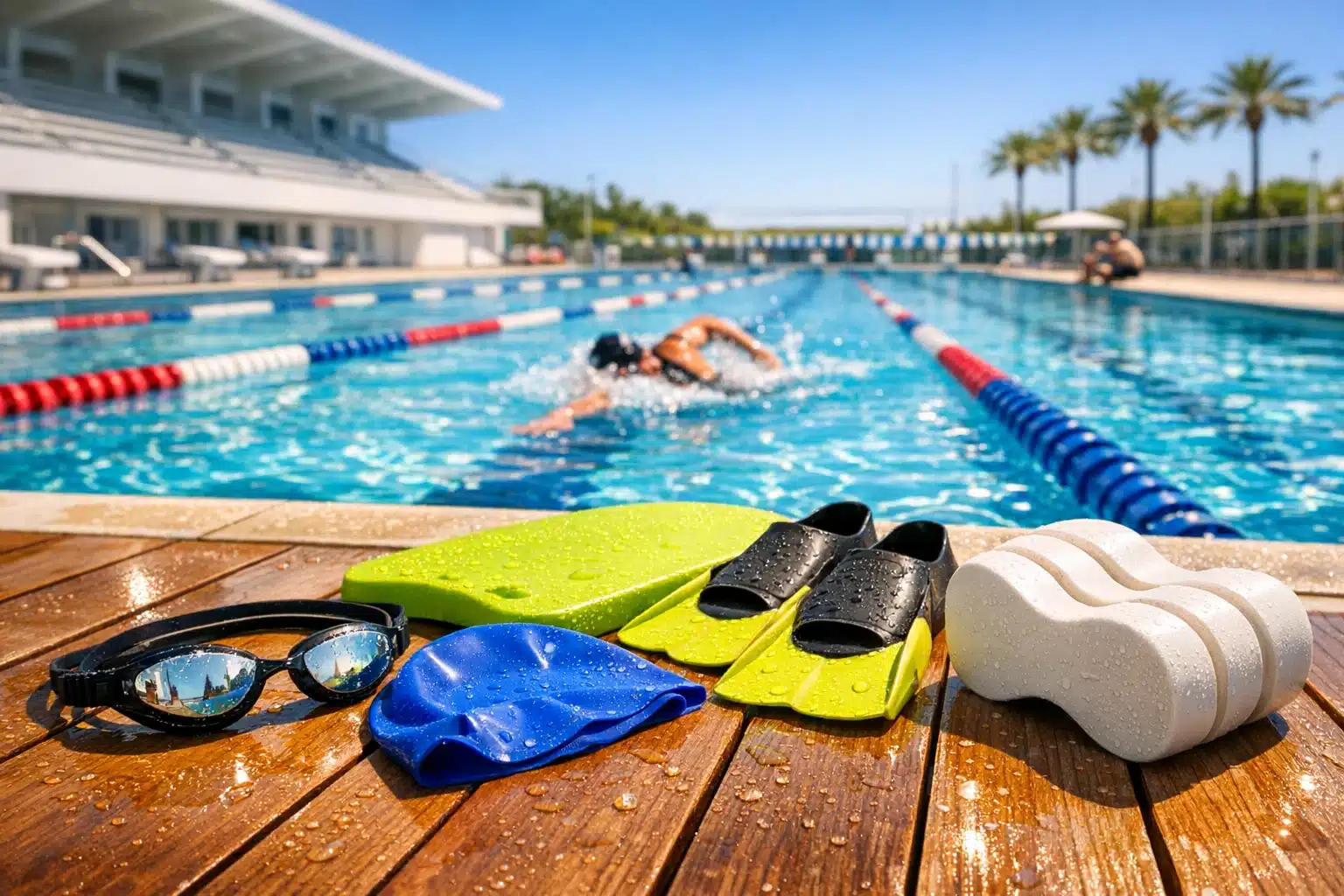
Equipment helps, but it should support skill rather than replace it. A comfortable swimsuit, goggles that seal properly, and a cap are often enough for most sessions. Kickboards, pull buoys, paddles, fins, and snorkels can be useful training tools when applied purposefully. The mistake is relying on gear to hide technical problems. Fins can make a swimmer feel faster, but they do not automatically fix alignment. Paddles can strengthen the pull, but they can also magnify poor mechanics.
Lane etiquette is another underappreciated part of training. Sharing space requires awareness, predictable movement, and respect for pace differences. A well-run lane feels like quiet cooperation in motion. Everyone is working hard, yet the experience stays orderly because swimmers understand where to rest, when to pass, and how to leave room at the wall. In that small social contract, swimming reveals one more lesson: improvement is personal, but the water is often shared.
Finding Your Place in the Water: A Practical Conclusion for Beginners, Parents, and Serious Swimmers
For most readers, the real question is not whether swimming is valuable. It is how swimming can fit into life in a realistic, lasting way. The answer depends on who is standing at the poolside. A beginner may need reassurance that awkward first sessions are normal. A parent may want lessons that build safety before speed. A fitness-minded adult may be looking for a sustainable workout that does not punish the joints. A competitive swimmer may be chasing tiny technical gains that separate good performances from excellent ones.
That range is one of swimming’s great strengths. It does not demand the same starting point from everyone. Some people begin by learning to float without fear. Others return after years away and rediscover that their lungs remember more slowly than their enthusiasm. Young athletes may learn discipline through early-morning practice, while older adults may find freedom in movement that feels gentler than land exercise. Swimming meets people where they are, but it rewards those who stay curious.
If you are deciding what to do next, a few practical steps can help:
• choose a clear goal, such as safety, fitness, technique, or competition
• start with instruction if breathing or confidence is still a barrier
• keep sessions regular rather than heroic
• track one small improvement at a time
• respect recovery, especially if shoulders begin to feel overloaded
The long-term appeal of swimming lies in its layered nature. At first it is about staying afloat. Then it becomes about moving more efficiently. Later it may become about health, routine, identity, or even joy. The same pool can host all of these meanings. One swimmer counts intervals with sharp focus. Another drifts through easy lengths after a stressful day. Both are participating in the same broad tradition of using water as a place to learn something useful about the body and mind.
So the best conclusion is also an invitation. If you are new, begin small and learn well. If you already swim, refine what you do with purpose. If you teach or support others, remember that confidence often grows before speed does. Swimming is not only a sport to watch or a workout to complete. It is a life skill, a discipline, and for many people, a calm blue space where progress becomes visible one length at a time.