Explore the world of swimming
Swimming sits at the crossroads of sport, skill, and everyday wellbeing, making it relevant to children learning confidence, adults seeking low-impact exercise, and older people protecting mobility. A pool can feel like a classroom one day and a refuge the next, because water asks for focus while easing pressure on joints. This article explores how swimming works, why it helps, and what readers should know before diving deeper. If you have ever wondered whether swimming is simply recreation or a truly complete activity, the answer is worth a closer look.
Outline: What This Article Covers and Why Swimming Matters
Before discussing strokes, training plans, or safety tips, it helps to understand the shape of the topic. Swimming is not just one thing. It is a survival skill, a competitive sport, a rehabilitation tool, a social activity, and for many people, a quiet form of moving meditation. That range is exactly why the subject deserves a structured article rather than a quick list of tips. Water changes how the body moves, how the lungs work, and even how the mind responds to effort, so a broad overview makes the rest of the discussion easier to follow.
This article is organized in a practical order. First, it explains the wider value of swimming, including physical and mental benefits that make it relevant well beyond the lane line. Next, it compares the main swimming strokes, because technique shapes both enjoyment and efficiency. After that, it moves into learning and training, covering the habits, drills, and equipment that help swimmers improve safely. Finally, it closes with a reader-focused conclusion that turns information into action, especially for beginners, returning adults, parents, and fitness-minded readers.
Here is the roadmap in simple form:
- Why swimming supports health, endurance, and recovery
- How freestyle, backstroke, breaststroke, and butterfly differ
- What makes technique efficient instead of exhausting
- Which training habits and safety principles matter most
- How different types of readers can start or return with confidence
Swimming remains widely relevant because it fits many settings. A child may enter the water to learn safety, a triathlete may use it to build race fitness, and an office worker may turn to it for joint-friendly exercise after long days at a desk. Public health guidance in many countries encourages at least 150 minutes of moderate aerobic activity per week, and swimming can contribute meaningfully to that target. It also offers an unusual blend of resistance and buoyancy: the body works against water while the joints experience less impact than they would during running or jumping.
If land-based sports often feel loud and urgent, swimming introduces a different rhythm. Every length has a small narrative arc: push, glide, pull, breathe, turn, repeat. That pattern is part of the appeal, and it is also why good information matters. The sections that follow will move from broad value to practical detail, giving readers a grounded, useful look at one of the world’s most accessible and enduring activities.
The Physical and Mental Benefits of Swimming
Swimming is often described as a full-body workout, and that label is deserved. A well-executed swim session engages the shoulders, back, chest, core, hips, and legs while also challenging the cardiovascular system. Unlike many exercises that emphasize one dominant movement pattern, swimming requires coordination across the whole body. The arms pull, the legs kick, the torso stabilizes rotation, and the lungs manage a breath pattern that must stay calm even when effort rises. That combination makes swimming both demanding and efficient.
One of its biggest advantages is low impact. Water supports body weight through buoyancy, which can reduce stress on the knees, ankles, and hips. For people with joint discomfort, those recovering from some injuries, or adults who want regular exercise without constant pounding, this matters a great deal. That does not mean swimming is effortless. Water creates strong resistance, so even moderate speeds can require meaningful muscular work. Many swimmers leave the pool feeling tired in the satisfying way that comes from using the entire body rather than one isolated area.
Swimming also supports aerobic fitness. Regular sessions can help improve endurance, circulation, and heart health when practiced consistently. The exact energy cost varies by stroke, pace, body size, and skill level, but most swimmers burn a substantial number of calories during a sustained workout. More importantly, swimming is scalable. A beginner may start with short lengths and generous rest, while an experienced swimmer may complete interval sets that build speed and stamina.
The mental side is just as important. The water strips away some distractions of daily life. You cannot scroll through messages in the middle of a lap, and that forced simplicity has value. Many swimmers describe a session as mentally clearing, partly because the rhythm of breathing and movement creates a steady internal focus. Research on exercise and mood regularly shows links between physical activity and reduced stress, and swimming fits well within that broader picture.
Its benefits often extend to specific groups:
- Children can build confidence, coordination, and water safety awareness
- Adults can use it for fitness, stress management, and active recovery
- Older adults may value the lower impact and support for mobility
- Athletes in other sports often use it to cross-train without repetitive impact
There is also a practical dignity to swimming. It teaches a person how to remain composed in an environment that does not naturally belong to humans. Learning to float, breathe, and move efficiently in water is more than exercise; it is a form of competence. That is part of why swimming stays with people. A good session can feel like work, relief, and progress all at once.
Understanding the Main Strokes and How They Compare
To someone watching from the pool deck, swimming may look smooth and almost uniform. In reality, the four main competitive strokes ask for very different skills and produce very different sensations in the water. Freestyle, backstroke, breaststroke, and butterfly each have their own rhythm, breathing pattern, muscular emphasis, and learning curve. Knowing how they compare helps readers choose where to begin and what to practice next.
Freestyle, usually swum with the front crawl technique, is the fastest and most commonly used stroke. The body stays as horizontal as possible while the arms alternate in a windmill-like action and the legs use a flutter kick. Because there is no formal rule requiring a specific style in freestyle races, front crawl dominates due to speed and efficiency. It suits fitness swimming well because once basic breathing is learned, it can be sustained for long distances. Its challenge lies in coordination: many beginners work hard but travel inefficiently because the head lifts too high, the body position drops, or the kick creates drag instead of propulsion.
Backstroke is often recommended as a useful companion to freestyle. It uses an alternating arm action and flutter kick, but the swimmer lies on the back. Since the face stays above water, breathing feels more relaxed for some learners. At the same time, backstroke demands spatial awareness because the swimmer cannot see where they are going without checking landmarks or flags. It encourages body alignment and can help balance muscle use across the shoulders when practiced with good technique.
Breaststroke is slower but often feels intuitive to new swimmers because the head can rise more naturally during the stroke cycle. Its pull and kick happen in a more symmetrical pattern, and timing matters enormously. When done well, breaststroke has a glide phase that feels almost quiet, as if the swimmer briefly borrows the stillness of the water instead of fighting it. However, poor technique can strain the knees or lower back, especially if the kick is forced or the head stays lifted too long.
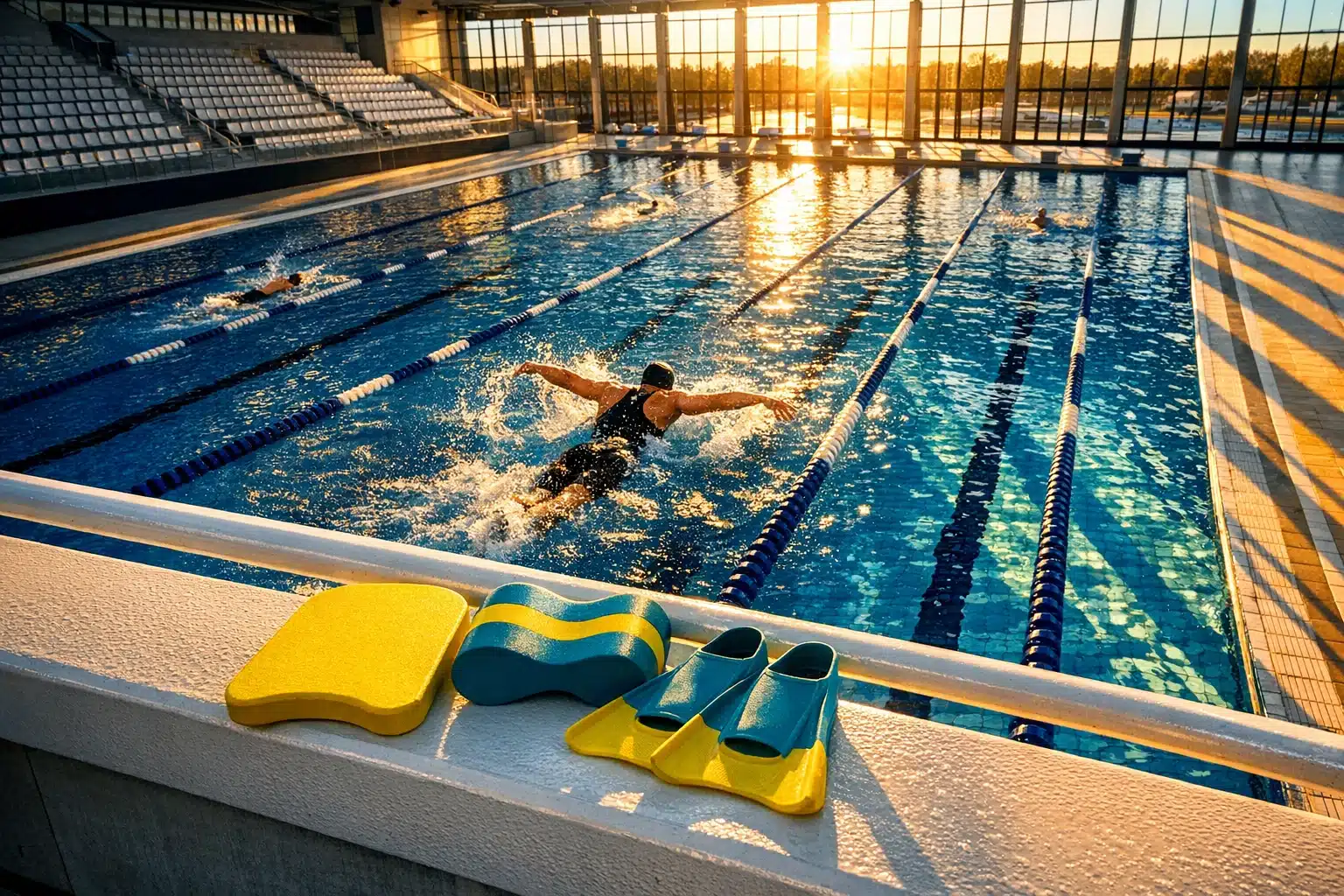
Butterfly is the most physically demanding of the four for most people. Both arms recover together over the water, and the body moves in a wave-like undulation powered by the core and a dolphin kick. It is beautiful to watch and exhausting to swim. Beginners should not feel discouraged if it seems difficult; even experienced swimmers treat butterfly with respect.
A simple comparison looks like this:
- Freestyle: fastest, efficient, excellent for endurance
- Backstroke: face-up breathing, strong for posture and balance
- Breaststroke: accessible rhythm, slower pace, timing-sensitive
- Butterfly: powerful and technical, highest energy demand for many swimmers
No stroke is universally best. The right choice depends on purpose. For lap fitness, freestyle usually leads. For variety and shoulder balance, backstroke helps. For controlled pacing, breaststroke has clear value. For power and technical challenge, butterfly stands alone. Together, the four strokes reveal swimming’s depth: it is not one movement repeated forever, but a language with distinct dialects.
Learning, Training, Equipment, and Safety in the Water
Improvement in swimming rarely comes from brute effort alone. In fact, trying harder without better technique often makes a swimmer more tired rather than more effective. Water rewards precision. A small adjustment in head position, body alignment, hand entry, or breathing timing can noticeably change how fast and relaxed a person feels. That is why strong training begins with skill before it chases speed.
For beginners, the first goals should be comfort, balance, and breath control. Learning to exhale steadily into the water is more important than swimming fast across a full pool. Many adults who say they are “bad swimmers” are really just under-practiced breathers with tense shoulders. Once breathing becomes more natural, the body usually settles and the stroke becomes smoother. Drills are helpful because they isolate one element at a time. A kick drill teaches propulsion and body line, a pull drill highlights arm mechanics, and side-balance work improves rotation for freestyle.
Training structure matters too. Instead of swimming until exhausted, many coaches use simple sets with rest intervals. For example, a swimmer might complete several short repeats with 15 to 30 seconds of rest, focusing on form. This approach builds endurance while keeping technique from collapsing. As ability grows, sessions can include:
- Warm-up lengths at easy effort
- Skill drills for breathing, kicking, or catch position
- Main sets for endurance, pace control, or speed
- Cool-down swimming to lower intensity gradually
Equipment can support learning when used correctly. Goggles improve visibility and reduce hesitation. A kickboard helps isolate the legs, though it should not replace balanced whole-stroke practice. A pull buoy can highlight body position and upper-body mechanics. Fins may help some swimmers feel propulsion and body line more clearly, but they are tools, not shortcuts. The essential gear remains simple: a well-fitting swimsuit, goggles, and access to water.
Safety deserves equal attention. In pools, swimmers should understand lane etiquette, rest at the wall without blocking others, and choose lanes that match their pace. Children require active supervision near water, even when lifeguards are present. Open-water swimming adds further complexity, including temperature, visibility, currents, boat traffic, and weather changes. Bright swim buoys, a partner system, and local knowledge are important precautions. Cold water in particular can affect breathing and muscle control much faster than many people expect.
The best swimmers are not always the strongest; they are often the most attentive. They notice how the water feels on the forearm during the catch, how the hips respond to the kick, and how tension builds when breathing becomes hurried. Swimming may look graceful from the outside, but that grace is usually built from patient repetition, safe habits, and a willingness to learn one detail at a time.
Conclusion for Beginners, Fitness Swimmers, and Lifelong Learners
Swimming rewards many kinds of people, which is part of its lasting appeal. If you are a beginner, it offers a skill that increases confidence and personal safety. If you are looking for exercise, it gives you a low-impact way to train the heart, muscles, and lungs together. If you are returning after years away, it can be one of the gentlest paths back into regular movement. And if you already enjoy sports, swimming can sharpen endurance, discipline, and body awareness in ways that carry over into daily life.
The most useful takeaway is that swimming should not be judged only by speed or distance. A successful session for one person may be ten careful minutes of breathing practice, while for another it may be a structured set of intervals or a long open-water swim. Progress in the pool is often quiet. One day the face stays relaxed. A week later the turn feels less awkward. Soon the water no longer feels like resistance alone; it starts to feel like feedback, almost like a teacher correcting you without speaking.
For readers deciding how to begin, a simple approach works best:
- Start with realistic sessions rather than ambitious ones
- Learn proper breathing before chasing speed
- Choose one or two strokes to practice consistently
- Use lessons or coaching if technique feels confusing
- Respect safety rules in pools, lakes, rivers, and the sea
Swimming does not demand a particular age, body type, or personality. It can be competitive, social, therapeutic, or quietly personal. Some people love the measured rhythm of lap counting. Others love the feeling of weightlessness, the hush under the surface, or the simple proof that they can do something hard and gradually make it easier. That flexibility is one of swimming’s greatest strengths.
For the target audience of this article, the message is practical: swimming is worth exploring because it combines health benefits, usable skill, and long-term accessibility in a way few activities do. You do not need to master butterfly or train for a race to gain something meaningful from it. Begin where you are, stay patient with the learning curve, and let steady practice do its work. In time, the pool stops being just a place to exercise and becomes a place to think clearly, move efficiently, and build confidence one length at a time.