Explore the world of swimming
Swimming turns water into a classroom, a gym, and sometimes a refuge from noise on land. Few activities ask the body to coordinate breath, balance, rhythm, and endurance all at once, yet the impact on joints stays gentler than in many running or jumping sports. It matters as a life skill as much as a workout, because confidence in the water can improve safety as well as fitness. The pages ahead explore swimming from its broad foundations to the details that help readers move through the water with more purpose.
Understanding Swimming: Scope, History, and a Practical Outline
Swimming is often reduced to a simple image: a person crossing a pool lane from one wall to the other. In reality, it is several things at once. It is a survival skill that can prevent drowning, a recreational activity that brings families together, a demanding sport measured in fractions of a second, and a lifelong form of exercise that adapts to different ages and abilities. Humans have swum for thousands of years. Ancient wall art, military training practices, and early bathing cultures all suggest that moving through water has long been connected to work, travel, play, and health. Modern swimming added standardized strokes, timed races, pool design, coaching systems, and a larger public-health role through lessons and aquatic safety programs.
This article follows a practical outline so readers can build understanding step by step:
• why swimming matters and how it developed
• what the body gains from water-based movement
• how the main strokes differ in speed, rhythm, and difficulty
• how to train safely and improve with intention
• why swimming remains relevant in sport, community life, and daily wellness
That structure matters because swimming is not learned only by copying arm motions. The experience depends on environment. A calm indoor pool is different from a cold lake, and both differ sharply from open ocean water shaped by current, wind, and visibility. Even the meaning of success changes with context. For one person, success is floating comfortably. For another, it is completing a triathlon swim or cutting two seconds from a 100 meter freestyle time.
Swimming also stands out for its accessibility and variety. People can swim for competition, rehabilitation support under professional guidance, social connection, or simple enjoyment. Equipment can be minimal, often limited to a swimsuit and goggles, though training tools such as kickboards, pull buoys, fins, and pace clocks add precision. Public pools, school programs, community centers, and open-water clubs all expand access, though cost and location still affect participation. That mix of simplicity and depth is part of swimming’s charm. At first glance, it is just movement in water. Look closer, and it becomes a language of timing, pressure, breath, and trust, where small adjustments can transform effort into flow.
How Swimming Benefits the Body and Mind
Swimming offers a rare physical profile because water changes the rules of movement. Water is far denser than air, so every stroke meets resistance from multiple directions. That means even controlled, smooth motion can challenge muscles in the shoulders, back, core, hips, and legs. At the same time, buoyancy supports the body. In chest-deep water, people bear far less body weight than they do on land, and deeper water reduces loading even more. This is why swimming and aquatic exercise are often recommended as lower-impact options for many people who want to stay active without the repeated pounding associated with some land-based sports. That does not make swimming easy; it makes the challenge different. Instead of impact, the body meets drag. Instead of stomping forward, it learns to slip, rotate, and press against water with purpose.
The cardiovascular benefits are a major reason swimming remains popular. Continuous lap swimming can elevate heart rate, train aerobic capacity, and improve endurance. Calorie expenditure varies by stroke, pace, body size, and experience, but moderate to vigorous sessions often burn several hundred calories per hour. Freestyle and butterfly usually demand more energy than gentle breaststroke or easy backstroke, though efficiency can change the picture. Swimming also trains breathing control in a way that many exercises do not. Because the face is periodically in the water, breathing must be timed rather than casual. Over time, swimmers often develop better awareness of breath rhythm, exhalation, and posture. The mental effect can be just as valuable. Repeating laps creates a steady pattern of movement that some people find meditative, while others enjoy the measurable progress of intervals and split times.
Different groups can benefit from swimming for different reasons:
• children can learn water confidence and basic safety
• office workers may enjoy it as a joint-friendly counterbalance to long hours of sitting
• older adults often value the support that water gives balance and mobility
• athletes in other sports use it for conditioning or active recovery
• people returning to exercise may find the pool less intimidating than a crowded gym
Still, swimming is not automatically ideal for every person or every injury. Technique problems can irritate shoulders, and beginners sometimes tire faster than expected because inefficient movement wastes energy. The key point is balance: swimming can be gentle on impact while still being highly demanding. Done thoughtfully, it builds endurance, coordination, mobility, and confidence all at once, which helps explain why a quiet pool can feel like both a workshop and a reset button.
Comparing the Main Strokes and the Skills Behind Them
The four competitive strokes, freestyle, backstroke, breaststroke, and butterfly, each ask the body to solve the same puzzle in a different way: how to move forward with as little wasted energy as possible. Freestyle, usually referring to front crawl in practice, is the fastest and most widely used stroke for fitness swimming. Its alternating arm action, flutter kick, and side breathing make it efficient for distance and versatile for training. Backstroke mirrors some of freestyle’s rhythm but places the swimmer face-up, which simplifies breathing while adding a new challenge: maintaining direction without seeing where one is going. Breaststroke is slower but highly technical, combining a simultaneous arm pull with a whip-like kick and a brief glide. Butterfly is the most demanding for many swimmers because it requires powerful timing, symmetrical arm recovery, and a dolphin kick driven from the core and hips.
A useful way to compare the strokes is by three factors: speed, energy cost, and coordination. Freestyle is generally the quickest and, when well learned, the most economical over long distances. Backstroke tends to be easier for some beginners who dislike putting the face in the water continuously, although body position can sag if the hips drop. Breaststroke feels intuitive to many new swimmers because the head can lift more often, but it is also the stroke most likely to hide technical inefficiency behind familiar motion. Butterfly is spectacular when done well and exhausting when done poorly. It often looks like a wave crossing the water, but the smooth image depends on careful timing rather than brute strength alone.
Several technical basics matter across all strokes:
• body alignment reduces drag more than people expect
• a stable head position helps the hips stay higher
• exhaling underwater prevents rushed, panicked breaths
• kicking should support the stroke, not fight it
• rotation, catch, and timing matter more than splashing
Beginners often assume hard effort will solve everything, yet swimming tends to reward precision first. A shorter, cleaner stroke can outperform a frantic one. For example, a swimmer who learns to hold a streamlined line after pushing off the wall may travel farther with less effort than someone who immediately thrashes into motion. This is one of swimming’s most humbling lessons: the water exposes wasted movement quickly. It is also one of its most satisfying lessons, because improvement can arrive through subtle changes. A better catch, a calmer breath, or a more patient kick can make the lane suddenly feel wider, quieter, and more cooperative.
Training, Safety, and a Realistic Path to Improvement
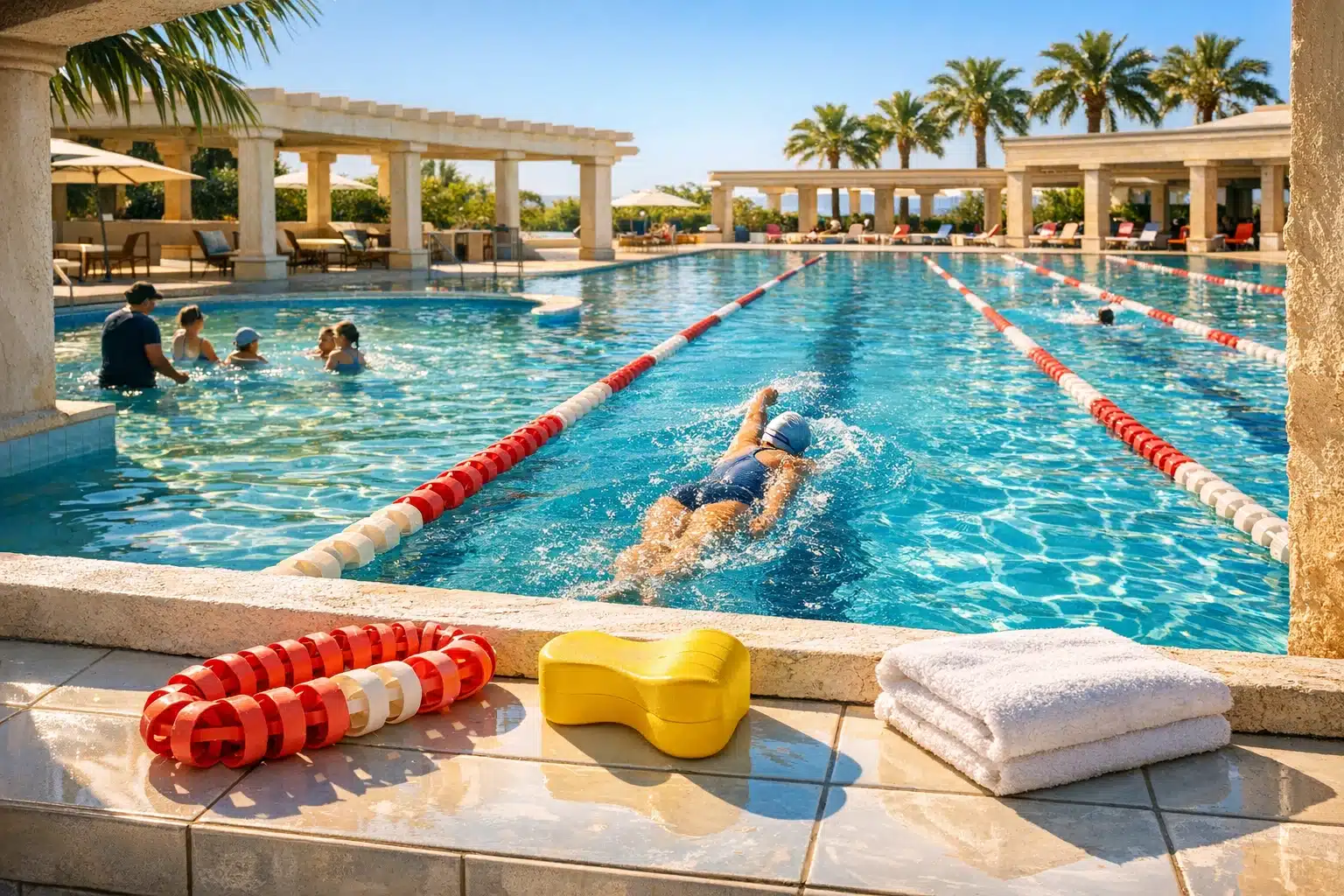
Good swim training is not just endless laps. Effective progress usually comes from combining technique work, structured endurance, rest, and feedback. Many swimmers divide sessions into clear parts: a warm-up, drills, a main set, and a short cool-down. Drills help isolate skills such as balance, catch position, rotation, or kick timing. Main sets then apply those skills under controlled fatigue. For example, a beginner may swim short repeats with generous rest, while an advanced athlete may use pace targets, heart-rate goals, or race-pace intervals. Equipment can support specific goals. A kickboard focuses attention on leg action, a pull buoy highlights upper-body mechanics, and fins can help swimmers feel body position and speed. None of these tools replaces technique; they simply shine a brighter light on one part of the puzzle.
Safety deserves equal emphasis because confidence in the water should never become carelessness. Pool swimmers should know lane etiquette, read depth markings, and avoid diving where it is not allowed. Open-water swimmers need even more caution. Water temperature, visibility, currents, wind, boat traffic, and shoreline access all matter. A strong pool swimmer may still struggle outside the pool because there are no lane lines, no walls for rest, and often no clear black line below to guide direction. Bright tow floats, swim partners, designated swim zones, and knowledge of local conditions reduce risk. Children should always be supervised around water, and adults should not overestimate their stamina. Fatigue can arrive quietly in swimming, especially when technique breaks down and breathing becomes rushed.
A realistic path to improvement is usually simple:
• learn to float, breathe out underwater, and relax first
• build comfort with short distances before chasing speed
• take lessons if technique feels confusing or stagnant
• track a few useful metrics such as time, distance, or stroke count
• increase difficulty gradually rather than heroically
For readers starting from scratch, even two or three short sessions per week can produce meaningful gains. For experienced swimmers, progress may come from details: cleaner turns, steadier pacing, or more efficient breathing patterns. Swimming has a way of rewarding patience. The lane does not negotiate, but it does give honest feedback. When training is structured and safety remains non-negotiable, improvement stops feeling mysterious and starts feeling earned.
Swimming as a Lifelong Practice and a Smart Choice for Readers
Swimming remains relevant far beyond the pool deck because it connects personal wellness to community life and organized sport. Schools use it to teach safety and confidence. Recreation centers offer public access that can serve children, workers, retirees, and people recovering their fitness after long breaks. Competitive pathways range from local age-group clubs to university programs, masters swimming, triathlon, para swimming, and elite international events. Standard competitions take place in 50 meter long-course pools or 25 meter short-course pools, while open-water events may stretch to 5 kilometers, 10 kilometers, or more. Those formats show how broad the sport really is. A person can love swimming without ever racing, yet competition has helped refine technique, training science, and coaching knowledge that recreational swimmers also benefit from.
There is also a cultural side to swimming that deserves attention. For some families, learning to swim is a basic rite of passage. For others, access is shaped by geography, income, transportation, or the availability of safe facilities. That reality matters. Drowning prevention, public lessons, and inclusive aquatic programs are not side issues; they are central to the social value of swimming. The sport becomes stronger when more people can enter it with dignity and proper instruction. Swimming can also be deeply personal. One swimmer chases medals, another manages stress after work, and another rediscovers movement after years away from exercise. The same water holds all three stories without forcing them into a single definition of success.
For readers considering swimming, the most useful conclusion is also the simplest: start where you are, not where you think a swimmer should be. If you are nervous, begin with lessons, shallow water, and a trusted instructor. If you already swim, focus on one technical habit at a time instead of trying to repair everything in a week. If you want fitness, consistency will matter more than dramatic single sessions. If you want enjoyment, choose the version of swimming that suits you, quiet morning laps, family recreation, coached practice, or open-water adventure with proper preparation. Swimming asks for humility at the start, but it often gives back more than expected: stronger lungs, steadier nerves, safer habits, and the strange pleasure of learning how to move well in a place humans were never meant to live, yet keep returning to with good reason.