Explore the world of swimming
Swimming is one of those rare skills that can save a life, strengthen the body, and quiet a busy mind at the same time. It belongs to sport, recreation, rehabilitation, and everyday safety, which makes it relevant far beyond the pool deck. From children learning to float to adults chasing fitness or confidence in open water, swimming meets people where they are. This article explores how it works, why it matters, and what keeps people coming back.
Outline: This article begins with the broad value of swimming, then moves through stroke technique, training and health science, safety and equipment, and finally the culture and long-term appeal of swimming for different kinds of readers.
The Value of Swimming: More Than a Sport
Swimming occupies a special place among physical activities because it blends practicality with pleasure. Many sports improve fitness, but few also function as a basic life skill. In a world filled with coastlines, rivers, lakes, hotel pools, and backyard water features, the ability to move calmly and competently in water can make a meaningful difference. Drowning remains a major global safety problem, which is why learning to swim is often treated as a public health priority, not merely a hobby. That practical foundation gives the sport unusual weight. When someone learns to swim, they are not only gaining access to exercise; they are gaining freedom, confidence, and a wider margin of safety.
Its physical appeal is just as strong. Water supports part of the body’s weight, which reduces impact on joints and makes swimming attractive for older adults, people recovering from injury, and those who find running uncomfortable. At the same time, water creates resistance in every direction, so even smooth movement becomes work. That combination of buoyancy and resistance is one reason swimming can build endurance, coordination, and muscular engagement without the pounding that often comes with land-based exercise. Public health guidelines commonly recommend at least 150 minutes of moderate aerobic activity each week for adults, and swimming can contribute directly to that target.
There is also a mental side that deserves attention. Pools have a strange way of shrinking noise. The repeated pull, kick, turn, and breath can become meditative, almost like a moving rhythm section under the thoughts of the day. For some people, swimming is social and lively; for others, it is one of the few places where concentration becomes simple. Its benefits often arrive in layers:
• safety in and around water
• cardiovascular conditioning
• low-impact movement for joints
• stress relief through rhythmic exercise
• access to recreation and community
That range helps explain why swimming stays relevant across ages and goals. A child may approach it as discovery, a teenager as competition, a busy adult as exercise, and an older swimmer as mobility with grace. Few activities travel so well through the timeline of a life.
Understanding the Strokes and the Mechanics Behind Them
At first glance, swimming can seem simple: get in, move forward, breathe, repeat. In reality, technique shapes almost everything. A skilled swimmer is not just strong; they are efficient. The water punishes wasted motion and rewards timing, balance, and line. This is why a smaller swimmer with refined form can often outperform a stronger beginner who fights the water on every lap. Good technique begins with body position. The more horizontal and balanced the body remains, the less drag it creates. Head position, hip height, kick rhythm, and even how the hand enters the water all influence whether a stroke feels smooth or exhausting.
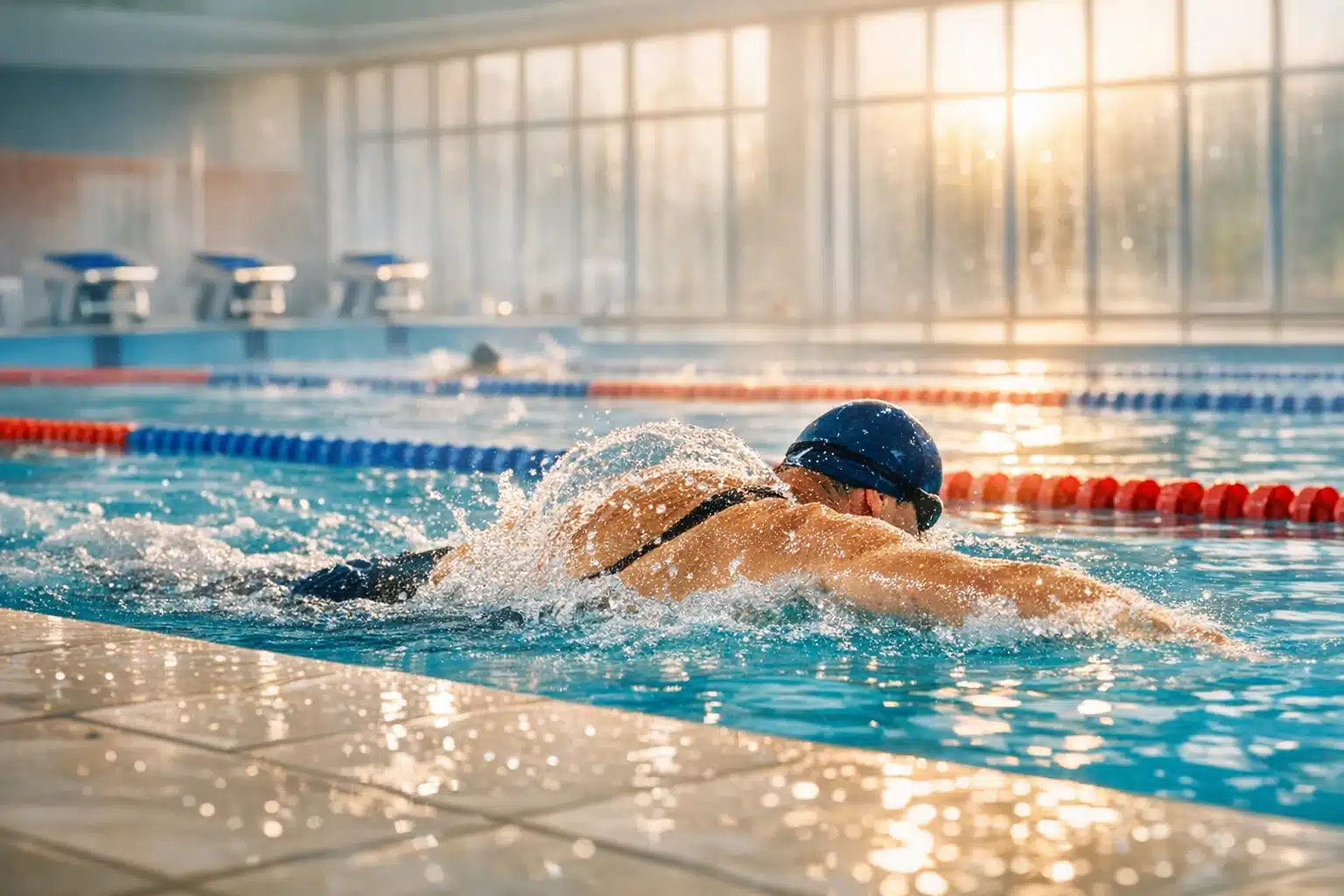
The four competitive strokes each teach different lessons. Freestyle, usually swum as front crawl, is generally the fastest and most efficient for distance. It relies on body rotation, alternating arm recovery, and a steady flutter kick. Backstroke shares some of that rhythm but turns the swimmer face-up, which can make breathing easier while introducing new challenges in alignment and navigation. Breaststroke is more cyclical and often easier for beginners to understand because the breath comes naturally during the arm recovery, but it requires careful timing and can be slow if the glide collapses. Butterfly is the most physically demanding for many swimmers, combining a simultaneous arm action with a wave-like body motion and dolphin kick. Beautiful butterfly looks almost airborne; poor butterfly looks like a negotiation with gravity.
Several technical themes run through every stroke:
• balance before power
• streamlined position off the wall
• controlled breathing instead of rushed gasps
• relaxed recovery and purposeful underwater pull
• timing that links arms, legs, and core
Comparisons matter because different strokes serve different purposes. Freestyle is often favored for fitness laps and triathlon. Breaststroke suits many recreational swimmers who want visibility and a comfortable pace. Backstroke can improve posture awareness and shoulder coordination when performed correctly. Butterfly, although less common in casual sets, develops rhythm, upper-body endurance, and body control. Beyond the strokes themselves, starts and turns can transform performance. In competitive settings, a powerful push-off and clean streamline may be the fastest part of the lap. Even recreational swimmers benefit from learning these details, because technique is not decoration. It is the engine room of efficient swimming.
Training, Endurance, and the Science of Swimming Fitness
Swimming is often described as a full-body workout, and that label is more than marketing shorthand. The arms generate propulsion, the legs stabilize and drive, and the core coordinates the entire movement so energy does not leak away. Because water is much denser than air, each stroke asks the body to push against continuous resistance. That makes even moderate sessions surprisingly demanding, especially for beginners who are still learning how to breathe efficiently. The first hard lesson of swim fitness is this: being fit on land does not automatically translate into comfort in the water. Many strong runners or cyclists are humbled by a few lengths in the pool, not because they lack effort, but because swimming taxes breathing patterns and technique in a very specific way.
Training usually improves through a mix of volume, structure, and skill work. A casual swimmer may start with short intervals and generous rest, such as 8 lengths broken into manageable sets. A more experienced swimmer might organize sessions around endurance, speed, drill work, and recovery. Typical tools include pull buoys, kickboards, fins, and pace clocks, but the basic training principles remain simple: consistency beats heroics, and technique under fatigue matters more than a single impressive workout. Lap swimming also allows precise control over effort, which makes it useful for people training for races, improving heart health, or rebuilding capacity after time away from exercise.
The health benefits are broad when training is sensible. Regular swimming can support cardiovascular fitness, improve muscular endurance, and help with energy balance when paired with appropriate nutrition. Calorie use varies widely by body size, stroke, and intensity, but the sport can be physically substantial without feeling as harsh as high-impact training. It is also popular in rehabilitation and active recovery because the water reduces load on joints. A well-designed swim week may include:
• easy aerobic sessions for base fitness
• drill-focused sets for technique
• interval work to build speed and stamina
• recovery swims with relaxed pacing
• dryland mobility or strength work to support shoulder health
One of the most useful comparisons is between swimming and gym-based cardio machines. Treadmills and bikes provide controlled, repeatable training, but swimming adds breath timing, buoyancy, and multidirectional resistance. It asks the body to become both powerful and economical. That challenge is exactly why progress feels so satisfying. A swimmer does not merely get stronger; they get cleaner, calmer, and more efficient in motion.
Learning Safely: Water Confidence, Equipment, and Smart Practice
Before swimming becomes graceful, it usually begins with awkward honesty. Water exposes tension quickly. New swimmers often lift the head too high, hold the breath too long, kick from the knees, or rush every movement as if the pool were trying to negotiate terms. That is normal. Learning safely means building confidence in layers rather than forcing progress through panic. Floating, exhaling into the water, gliding from the wall, and recovering balance after a breath are small skills, but they form the grammar of everything that follows. Instructors frequently emphasize comfort first because fear narrows attention, while calm makes technique possible.
Safety deserves more than a passing note, especially because swimming takes place in environments that look friendly right up until conditions change. A clear pool still demands awareness of depth, lane etiquette, and fatigue. Open water adds currents, waves, temperature shifts, limited visibility, and the challenge of swimming without lane lines or walls. Even strong pool swimmers can feel disoriented in a lake or sea. Smart practice starts with preparation:
• swim where supervision or lifeguards are available when possible
• learn basic floating and treading water before chasing speed
• respect weather, water temperature, and posted local warnings
• use bright caps or visibility gear in open water
• never assume fitness replaces judgment
Equipment can help, though it cannot replace skill. Goggles improve vision and reduce irritation. A well-fitted swimsuit reduces drag and distraction. Caps keep hair contained and make swimmers easier to spot. Kickboards and pull buoys isolate parts of the stroke for training, while fins can help beginners experience better body position and propulsion. In open water, a tow float may improve visibility and provide a place to rest. The best gear solves a clear problem instead of creating a false sense of mastery.
For adults who never learned to swim, the biggest barrier is often embarrassment rather than ability. Yet adult lessons are increasingly common, and good programs treat learning with respect. Progress may feel slow at first, but it is rarely random. Confidence grows when the body collects proof: one longer float, one calmer breath, one smoother length. Safety is not just about avoiding danger; it is about replacing guesswork with competence. Once that shift happens, the water stops feeling like an obstacle and starts feeling like a place you understand.
Beyond Laps: Competition, Community, and a Lifelong Relationship with Water
Swimming does not end at technique charts and training sets. It also has a rich culture that stretches from school lessons to Olympic finals, from masters clubs to quiet sunrise swims in cold lakes. Competitive swimming is highly structured, with standardized pool lengths, timed races, rankings, and precise rules for starts, turns, and stroke legality. Watching elite swimmers can be thrilling because their control seems almost mechanical, yet the appeal is human at its core: preparation, nerve, discipline, and tiny margins. A fraction of a second can separate medals, which gives the sport an intensity that casual viewers often underestimate.
Outside formal competition, swimming communities can be surprisingly varied. Some swimmers love lane sessions and measurable progress. Others prefer water polo, artistic swimming, triathlon, surf swimming, or open-water events where strategy and conditions matter as much as raw speed. There are also therapeutic and social dimensions. Masters programs welcome adults of mixed ability. Community pools provide routine and connection. Adaptive swimming opens participation to athletes with different physical needs, showing clearly that the sport can be adjusted without losing its challenge or dignity.
Part of swimming’s lasting power comes from the atmosphere around it. Pool decks have their own language: the clipped slap of flip-flops, the echo of whistles, the fog on early-morning windows, the quiet moment before pushing off the wall. Water remembers effort in a different way from land. It does not keep footprints, but it keeps habits. Show up often enough, and the body begins to anticipate the rhythm.
For readers wondering whether swimming is worth their time, the answer depends less on perfection than on fit. If you want a practical skill, swimming qualifies. If you want lower-impact exercise with real conditioning value, it delivers. If you want a sport that can be solitary one day and social the next, it offers both. The best reason to start may be the simplest one: swimming grows with you. It can begin as a lesson, become a workout, turn into a challenge, and settle into a lifelong companion. That makes it more than a pastime. It makes it a durable part of a healthy, capable, and curious life.