Explore the world of swimming
Swimming is one of those rare activities that can feel playful and serious at the same time. A child splashing in the shallow end, a triathlete chasing seconds, and an older adult easing sore joints through steady laps are all practicing the same elemental skill. It is exercise, transport, therapy, and safety training folded into one. In a world crowded with trends, swimming stays refreshingly simple: water, movement, breath, and the quiet lesson that progress arrives stroke by stroke.
Outline of the article:
• Why swimming remains one of the most valuable physical skills people can learn.
• How the major strokes work and what makes each one distinct.
• What science and training principles reveal about fitness, endurance, and recovery in the water.
• Why safety, instruction, and suitable equipment shape better outcomes.
• How swimming fits into recreation, competition, community life, and long-term wellbeing.
Why Swimming Matters Beyond the Pool
Swimming deserves its reputation as more than just another sport. It is a practical life skill, a form of exercise, and in many places a cultural tradition. Humans have used swimming for travel, fishing, rescue, military training, and recreation for thousands of years. Today, its appeal is just as broad. Some people swim to improve cardiovascular fitness, some to recover from injury, and others simply because water offers a kind of freedom that land does not. Few activities can shift so easily between necessity and enjoyment.
One reason swimming stands out is accessibility across life stages. A teenager may use it to build endurance, a pregnant adult may appreciate its reduced joint impact, and an older swimmer may rely on it to stay active without the pounding associated with running. Water supports body weight, which lowers stress on knees, hips, and the spine. At the same time, it adds resistance in every direction. Because water is much denser than air, even simple movements become meaningful work. That combination of support and resistance is rare, and it explains why swimming is often used in both fitness programs and rehabilitation settings.
Swimming also carries a public safety dimension that should not be underestimated. Being able to float, tread water, and move efficiently through water can reduce drowning risk. According to global public health data, drowning remains a major cause of accidental death, especially among children. That fact gives swimming lessons a significance that goes far beyond leisure. In this sense, learning to swim is closer to learning road safety than taking up a hobby. It can be enjoyable, but it can also be protective.
Compared with land-based workouts, swimming offers a distinctive sensory experience. Running often emphasizes impact and rhythm. Cycling highlights cadence and mechanical efficiency. Swimming adds breath control, buoyancy, and constant contact with a moving environment. Every stroke asks the body to negotiate balance, resistance, and timing. That is why many beginners find it humbling. Water does not care about ego; it rewards technique, patience, and calm repetition.
Several features explain its lasting relevance:
• It combines skill development with physical conditioning.
• It can be recreational, therapeutic, or highly competitive.
• It teaches water confidence, which has real-world value.
• It can be practiced indoors or outdoors in many formats.
For readers deciding whether swimming is worth their time, the answer often depends on what they want from movement. If they want intensity, swimming can provide it. If they want low-impact activity, it delivers that too. If they want a habit that can remain useful for decades, swimming is one of the strongest candidates. Like stepping into a lake at dawn, it can feel bracing at first, but it tends to wake up more than muscles. It sharpens attention, builds respect for the environment, and reminds people that progress is not always loud.
Understanding the Main Strokes and the Craft of Technique
To the casual observer, swimming may look straightforward: enter the water and move forward. In practice, technique determines whether the experience feels smooth and energizing or exhausting and chaotic. The four competitive strokes, freestyle, backstroke, breaststroke, and butterfly, all solve the same problem in different ways. Each uses a specific body position, kick pattern, breathing rhythm, and arm action. Learning these differences helps swimmers choose the stroke that suits their goals, confidence level, and physical condition.
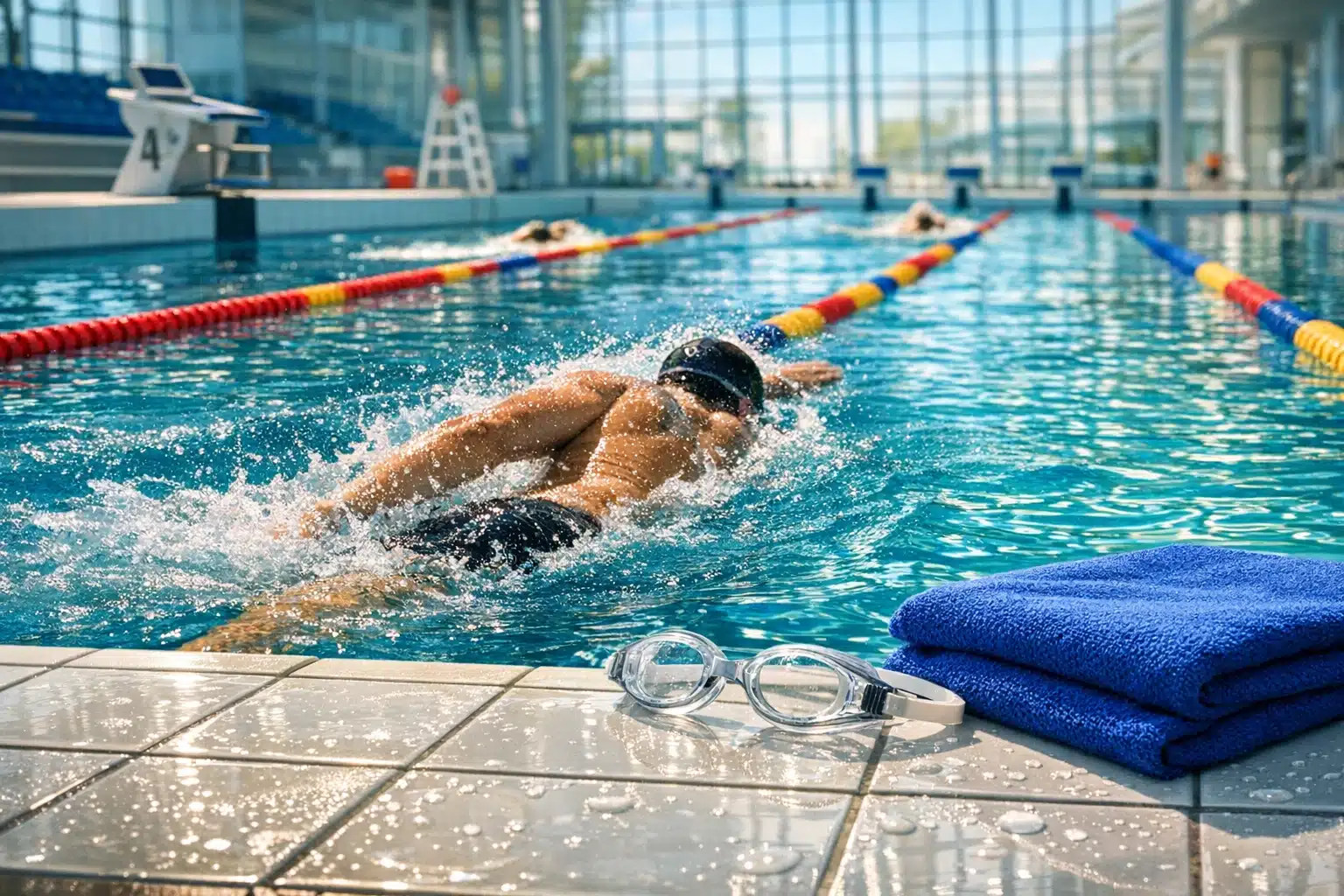
Freestyle, usually swum using the front crawl, is the fastest and most widely taught stroke for fitness. The body stays long and horizontal, the arms alternate in a windmill-like pattern, and the flutter kick keeps the hips high. The challenge is breathing without disrupting alignment. Skilled swimmers rotate through the torso rather than lifting the head sharply, because excessive head movement makes the legs sink and increases drag. Freestyle is often compared to a well-tuned bicycle: when the mechanics are efficient, speed seems to come with less effort.
Backstroke shares some features with freestyle but reverses the body position. Swimmers lie on their backs, alternate the arms, and use a flutter kick. Many beginners appreciate that breathing is less stressful because the face stays out of the water. However, backstroke demands awareness of direction and body roll. A drifting line can quickly send a swimmer off course. It is often a useful bridge stroke for people building confidence because it blends motion with easier breathing.
Breaststroke is slower but highly technical. The arms sweep outward and inward together, while the legs perform a whip kick. Timing matters enormously: pull, breathe, kick, glide. When done well, breaststroke feels measured and controlled. When mistimed, it feels like driving with one foot on the brake. It is popular in learn-to-swim programs because the head can stay above water more often, though the stroke still requires discipline to avoid unnecessary strain on the neck and knees.
Butterfly is the most demanding of the four. Both arms recover over the water at the same time, and the legs perform a dolphin kick powered by the hips and core. To watch a strong butterfly swimmer is to watch effort turned into rhythm. It can look almost theatrical, but its beauty depends on precision. Poor timing leads to rapid fatigue.
Across all strokes, a few principles matter more than people expect:
• Streamline reduces drag.
• Controlled breathing supports endurance.
• Body rotation improves reach and power.
• Consistent practice beats occasional heroic effort.
Technique is not decorative; it is functional. A swimmer with moderate fitness and sound mechanics often travels farther than a fitter person who fights the water. That is one of the sport’s quiet truths. Improvement usually begins not with stronger arms, but with better balance, cleaner timing, and a calmer relationship with breath.
The Science of Swimming: Fitness, Strength, and Recovery
Swimming is frequently described as a full-body workout, and that phrase is accurate when understood properly. In the water, the upper body drives much of the propulsion, especially in freestyle and butterfly, while the core stabilizes rotation and the legs support balance, kicking power, and body position. Unlike some gym exercises that isolate a small muscle group, swimming asks multiple systems to cooperate continuously. That makes it valuable for cardiovascular conditioning and muscular endurance rather than brute strength alone.
From a physiological standpoint, swimming trains the heart and lungs in a distinctive way. Repeated lap work raises heart rate and challenges oxygen delivery, but breathing is controlled by the stroke cycle rather than being entirely spontaneous. This can improve respiratory efficiency and awareness of pacing. Many training plans use sets, such as repeated 50- or 100-meter efforts with rest intervals, because these structures develop aerobic capacity while allowing swimmers to focus on technique under manageable fatigue. Longer continuous swims build endurance, while shorter, faster repeats improve speed and anaerobic tolerance.
Water itself changes the equation. It provides resistance in all directions, so the body works during both pulling and recovery phases, even if that work is subtle. At the same time, buoyancy reduces impact forces. For people managing arthritis, recovering from certain injuries, or returning to exercise after a long break, this balance can be especially appealing. Swimming will not suit every condition, and medical guidance matters in rehabilitation, but its low-impact profile gives it a place few sports can claim.
Calorie expenditure in swimming varies widely by body size, stroke choice, intensity, and skill level. A relaxed breaststroke session and a hard butterfly workout are not remotely the same demand. More importantly, energy use in swimming is often underestimated because water cools the body efficiently. A person may work hard without the dramatic sweat cues they rely on during land training. That can make sessions feel deceptively gentle even when they are metabolically substantial.
Mental benefits also deserve mention. Rhythmic lap swimming can create a focused, almost meditative state. Counting strokes, feeling the catch of the hand in the water, and syncing breath with movement can narrow attention in a useful way. For some, the pool becomes a place where outside noise quiets down. It is not magic, and it does not replace mental health care, but it can support stress management and routine.
Swimming is especially effective when expectations are realistic:
• It improves fitness, but progress depends on consistency.
• It supports recovery, but technique and supervision still matter.
• It can aid weight management, but diet and total activity remain important.
• It strengthens the body, though not in the same way as heavy resistance training.
In short, the science behind swimming explains why it remains so widely recommended. It develops endurance, coordination, and movement quality at the same time. That combination makes it less like a single tool and more like a well-stocked toolbox.
Learning Safely: Lessons, Water Awareness, and Smart Preparation
Swimming is enjoyable partly because water invites play, but safety must stay at the center of any serious discussion. Confidence and competence are not the same thing. Someone may feel relaxed near water and still lack the skills needed to respond to fatigue, cold, unexpected depth, or panic. That gap matters. Formal instruction, attentive supervision, and clear safety habits often determine whether swimming remains a healthy activity or becomes a risky one.
For beginners, the best lessons usually start with fundamentals that seem modest but are actually foundational: entering and exiting the pool safely, blowing bubbles, floating on the front and back, kicking with support, and recovering to a standing position. These skills build familiarity before speed becomes a goal. Good instructors know that fear cannot be bullied away. A calm, progressive approach works better than forcing a swimmer into tasks that feel overwhelming. Learning to swim is not just about motion; it is about building trust in the body and in the environment.
Parents often assume that a few lessons make a child “water safe,” but that phrase can be misleading. Children still need constant supervision around pools, lakes, and beaches, regardless of lesson history. Barriers such as pool fences, lifeguards where available, and close adult attention remain critical. In open water, conditions add extra uncertainty. Waves, currents, cold temperatures, murky visibility, and sudden drop-offs can challenge even experienced swimmers. A calm pool lane and a windy coastline are completely different classrooms.
Equipment plays a supporting role. Goggles improve visibility and reduce irritation from chlorinated water. Swim caps help some swimmers manage hair and slightly reduce drag. Kickboards, pull buoys, and fins can isolate aspects of technique during training, but they are tools, not shortcuts. For open water, bright caps and tow floats improve visibility to others. New swimmers should be cautious with gear marketed as confidence boosting, because some products encourage dependency rather than skill.
Useful safety habits include:
• Never overestimating stamina, especially in unfamiliar water.
• Resting when breathing becomes ragged instead of pushing through panic.
• Swimming with others whenever possible.
• Checking depth, water quality, weather, and posted rules before entering.
• Respecting lifeguard instructions and local conditions.
One of the most important lessons in swimming is humility. Strong athletes from other sports sometimes assume fitness alone will carry them. Water teaches otherwise. Technique, temperature, visibility, and emotional control all matter. The safest swimmers are not the boldest; they are the most prepared. They know how to float, when to stop, and why caution is not weakness but competence expressed wisely.
Swimming as Recreation, Competition, and a Lifelong Habit
Once the basics are in place, swimming opens into several worlds at once. For some people it becomes a recreational ritual, an early-morning lane session before work or a gentle weekend swim with family. For others it turns into structured sport, complete with intervals, race strategy, and technical analysis. There is also a large middle ground: fitness swimmers, masters athletes, triathletes, aqua exercise participants, and open-water enthusiasts who are not chasing medals but do enjoy goals. This flexibility is one of swimming’s greatest strengths. It grows with the swimmer instead of demanding a single identity.
Competitive swimming offers a good example of how deep the discipline can go. Athletes train starts, turns, underwater phases, pacing, stroke count, and split times with great precision. A race lasting under a minute may represent years of refined technique. Yet the spirit of improvement is not reserved for elite pools. An adult learner cutting ten seconds from a 100-meter freestyle can feel a triumph every bit as personal as a podium finish. Swimming rewards measurable progress, and that makes it motivating for people who like clear feedback.
Recreational swimming brings different benefits. It can be social without being chaotic, challenging without being punishing. Community pools often serve as local meeting points where children learn, adults exercise, and older residents stay active. In that sense, swimming supports public health and social connection at the same time. There is also something uniquely restorative about moving through water on a hot day or gliding through a quiet pool when the surface looks like polished glass. Not every valuable activity has to be productive in a narrow sense. Sometimes its worth lies in how it resets the mind.
Open-water swimming has grown in visibility, but it deserves respect. Lakes, rivers, and seas offer beauty and adventure, yet they remove the predictability of lane lines and tiled walls. Navigation, sighting, temperature management, and group safety become central skills. Many swimmers find these challenges deeply satisfying because they reconnect the sport to nature. Instead of following black lines at the bottom of a pool, they learn to read currents, light, and distance in a living environment.
For people hoping to make swimming a lasting habit, a few strategies help:
• Choose a format that fits your lifestyle, not an idealized version of someone else’s routine.
• Track consistency before obsessing over speed.
• Mix skill work, easy sessions, and harder efforts.
• Join a class, club, or lane group if motivation fades alone.
• Keep goals flexible as age, work, and health change.
Swimming lasts because it can be many things without losing its identity. It can be playful, disciplined, solitary, communal, local, or adventurous. That range is rare. A person may begin by learning not to fear deep water and end years later using the same skill for fitness, friendship, and quiet confidence.
Conclusion for Beginners, Parents, and Fitness-Minded Readers
Swimming is worth exploring because it combines practical safety, technical learning, and meaningful physical activity in a single practice. For beginners, it offers a skill that can be built step by step without needing to master everything at once. For parents, it highlights the value of lessons while reinforcing that supervision and water awareness remain essential. For fitness-minded readers, it provides a low-impact but demanding option that can support endurance, mobility, and long-term consistency. If you are thinking about starting, begin simply: learn the basics well, respect the environment, and let improvement come gradually. The water rarely rewards hurry, but it responds generously to patience.