Explore the world of swimming
Swimming is one of the rare activities that feels playful while asking nearly every muscle to join the effort. It can be a life skill, a competitive sport, a form of low-impact exercise, and for many people, a reliable way to clear the mind after a crowded day. From children learning to float to adults chasing faster lap times, the water offers challenge, freedom, and practical safety all at once. That mix of enjoyment and usefulness keeps swimming relevant in schools, clubs, fitness centers, and communities around the world.
Outline
- The broad appeal of swimming and why it remains globally important
- Physical and mental health benefits compared with other forms of exercise
- The major strokes, technical basics, and how swimmers develop efficiency
- Training methods, equipment choices, and essential safety practices
- How beginners, families, athletes, and older adults can make swimming part of life
Why Swimming Matters More Than Many People Realize
Swimming often enters conversation as a hobby or a summer activity, yet its real importance reaches much further. It is both a sport and a survival skill, which already makes it unusual. A person may swim for medals, for health, for rehabilitation, or simply to feel lighter than gravity usually allows. In many places, swimming lessons are treated as a public safety priority because water is part of daily life, travel, or recreation. Beaches, lakes, rivers, hotel pools, and backyard pools all create situations where confidence in the water can make a meaningful difference.
Historically, swimming has deep roots. Variations of aquatic movement appear in ancient cultures, military training, and traditional recreation. In modern sport, swimming has been part of the Olympic Games since 1896, with women’s Olympic swimming added in 1912. That long competitive history has helped shape technique, timing systems, pool design, and coaching science. A standard long-course competition pool measures 50 meters, while short-course formats often use 25-meter or 25-yard pools. These details may seem technical at first glance, but they show how structured and refined the sport has become over time.
Swimming also stands out because it welcomes very different kinds of participants. One lane may hold a teenager training for regional competition, while another is used by an older adult rebuilding strength after an injury. Unlike some sports that strongly favor a narrow age range, swimming adapts well across life stages. Water supports the body through buoyancy, reducing impact on joints while still creating resistance in every direction. Because water is far denser than air, even simple movements require controlled effort. That is why a relaxed session can still feel productive.
Its broad value can be seen in several areas:
- Education: children learn water confidence and basic rescue awareness
- Health: adults use swimming for cardiovascular exercise and mobility
- Competition: clubs and schools develop athletes through structured programs
- Community: public pools create social spaces across age groups
There is also something quietly dramatic about entering a pool. Street noise fades, breathing becomes deliberate, and movement turns rhythmic. Few activities shift the body and mind so completely within the first minute. That change is part of swimming’s power. It is not merely exercise done in water; it is a distinct environment that teaches control, patience, and respect for technique.
The Physical and Mental Benefits of Swimming
One reason swimming endures is that it offers a rare balance of effectiveness and accessibility. From a fitness perspective, it trains the cardiovascular system, engages large muscle groups, and improves coordination without the pounding associated with many land-based workouts. For people who struggle with joint discomfort, excess body weight, or recovery from certain injuries, water can feel like an equalizer. Buoyancy reduces loading on the knees, hips, and spine, while resistance remains constant. In simple terms, swimming lets the body work hard without always feeling battered afterward.
The physical benefits are broad. Lap swimming can improve endurance, muscular stamina, posture, and breath control. Depending on stroke choice, pace, and body size, an hour of swimming may burn several hundred calories, often in a range similar to brisk cycling or steady jogging. Freestyle and butterfly demand strong shoulder and core involvement, breaststroke emphasizes timing and leg drive, and backstroke challenges alignment and upper-body coordination in a different way. Because the body must stabilize itself against moving water, even small corrections recruit supportive muscles that gym machines may ignore.
Swimming also deserves more recognition for its mental effects. The repetitive sound of splashing, the measured pattern of inhaling and exhaling, and the visual simplicity of moving across a lane can create a focused, almost meditative state. Many swimmers describe a session as a reset button. This is not magic, and it does not replace mental health care when professional support is needed, but regular exercise is widely linked with better mood, reduced stress, and improved sleep. Swimming contributes to that picture in a particularly calming way because the environment itself limits distraction.
Compared with some other activities, swimming offers a distinct combination of gains:
- Versus running: lower impact on joints, though usually less weight-bearing stimulus for bone health
- Versus cycling: more full-body engagement, especially through the upper body and trunk
- Versus walking: often greater cardiovascular challenge in less time, depending on intensity
- Versus strength machines: better continuous breath control and movement integration
Another major benefit is scalability. A beginner can start with short lengths and rest often. An advanced swimmer can complete interval sessions, drill sets, and endurance work that leave no doubt about the sport’s intensity. In other words, swimming does not belong only to elite athletes or leisure bathers. It creates room for both, and that flexibility is a large part of its staying power.
Understanding the Main Strokes and the Art of Efficient Movement
At first, swimming can seem like a simple act of moving from one end of the pool to the other. In practice, technique changes everything. Two swimmers may work equally hard, yet the one with better body position and timing will often travel faster while using less energy. That is why coaches speak so often about efficiency. Water punishes wasted motion. A lifted head can drop the hips, a rushed kick can break rhythm, and a hurried pull can reduce propulsion. Good swimming looks smooth not because it is easy, but because the swimmer has learned how to cooperate with the water instead of fighting it.
The four competitive strokes each have their own personality. Freestyle, usually swum as front crawl, is the fastest and most commonly practiced. It depends on a long body line, rotating through the torso, and breathing without disrupting momentum. Backstroke uses a similar alternating arm action while the swimmer faces upward, which makes navigation easier in a pool but demands careful alignment. Breaststroke is often the most familiar stroke to casual swimmers because the breathing pattern feels direct, yet it is highly technical; timing the pull, breath, kick, and glide matters more than raw force. Butterfly is the most dramatic and demanding, built on simultaneous arm recovery, a strong undulating body action, and precise rhythm.
For newer swimmers, the basic progression usually starts with floating, kicking, and exhaling in the water. Confidence comes before speed. A swimmer who learns to relax the neck, keep the face calm, and release air steadily will progress more reliably than someone who rushes toward harder sets. Drills help break complex motions into smaller pieces. Catch-up freestyle, one-arm backstroke, breaststroke timing drills, and dolphin kick practice all train awareness that full-speed laps can hide.
Important technical themes appear across all strokes:
- Body position: staying balanced and streamlined reduces drag
- Breathing: calm timing prevents panic and preserves rhythm
- Propulsion: effective pulls and kicks matter more than frantic movement
- Timing: the best stroke is coordinated, not merely forceful
Watching skilled swimmers can feel a bit like watching birds use air currents. Their effort is real, but the motion has economy. That is the lesson technique offers every swimmer. Speed is impressive, yet efficiency is what unlocks it.
Training, Equipment, and Safety in the Pool and Beyond
A good swimming routine is built on consistency rather than drama. Many people imagine progress arriving through punishing sessions, but most improvement comes from regular practice with a sensible mix of endurance, technique, and recovery. A typical workout might begin with an easy warm-up, followed by drills, then a main set designed around distance or speed, and finally a relaxed cooldown. For example, a recreational swimmer may complete short repeats with rest between them, while a competitive athlete may train with timed intervals that sharpen pacing and efficiency under fatigue. The structure matters because it turns random laps into purposeful training.
Equipment can support that process, though it should never replace sound basics. Goggles help with comfort and visibility. A well-fitted swimsuit reduces distraction. Caps are practical for managing hair and reducing drag, especially in training groups. Kickboards isolate leg work, pull buoys emphasize upper-body mechanics, and fins can improve body position when used thoughtfully. Paddles increase resistance and highlight errors in the catch, but they should be introduced carefully to avoid shoulder strain. Technology also has a role now; waterproof watches can track pace, distance, and stroke count, giving swimmers feedback that once belonged mostly to elite programs.
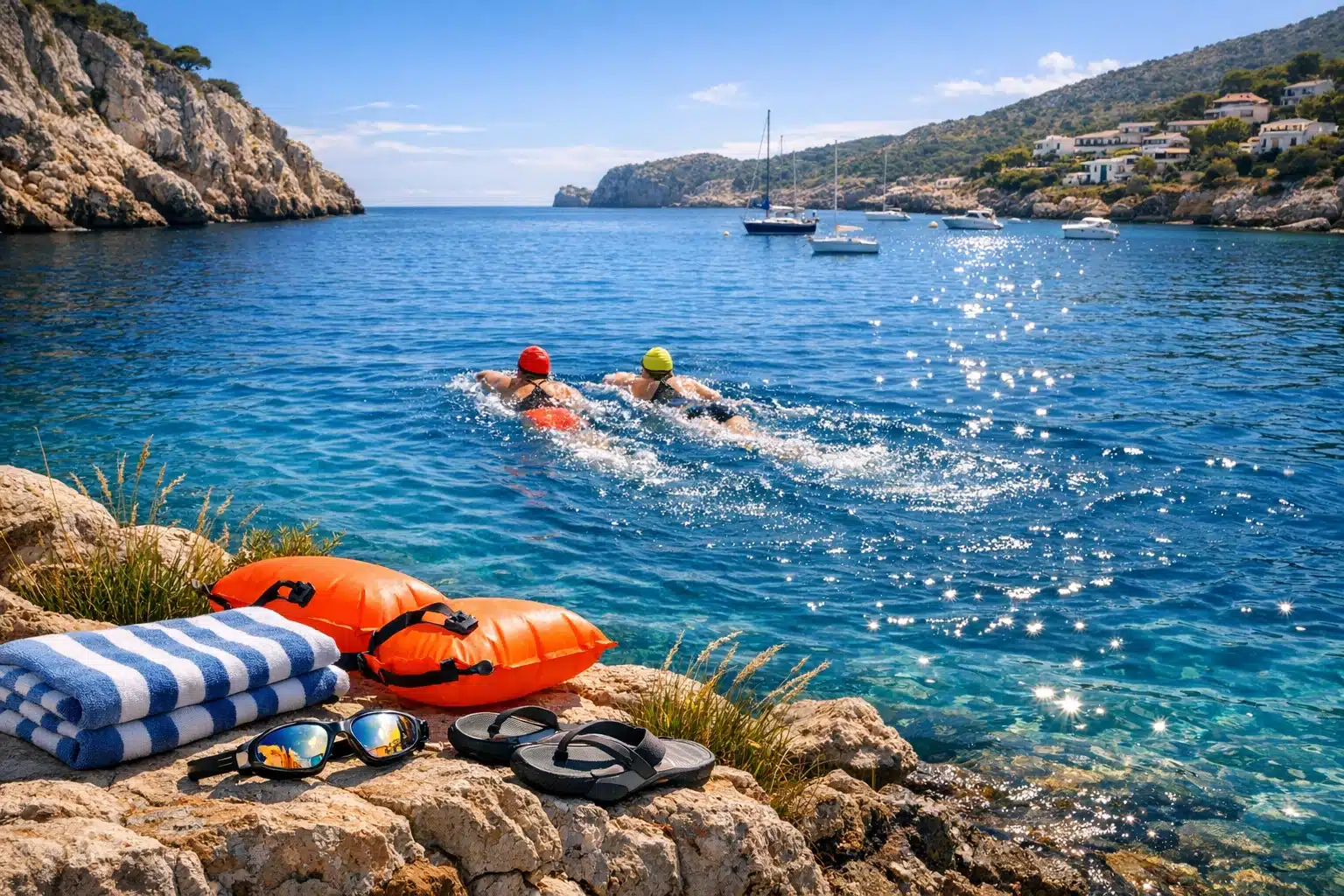
Safety, however, remains more important than performance. Strong swimmers still need caution because pools, lakes, and oceans present different risks. In a pool, hazards may include slippery decks, overestimating ability, or swimming alone without supervision. Open water adds currents, waves, changing temperature, reduced visibility, and navigation challenges. A calm lake can become tiring quickly when there is no wall to grab and no lane line to follow. That is why open-water swimmers often use bright caps, tow floats, and a buddy system.
Practical safety habits include:
- Learning basic water survival and floating skills before chasing speed
- Respecting lifeguard instructions and posted pool rules
- Entering unfamiliar water gradually and checking depth first
- Avoiding hard training when ill, exhausted, or poorly hydrated
- Using sun protection and visibility gear during outdoor sessions
Training well means listening to the body too. Shoulder tightness, cramping, and persistent fatigue are signals, not inconveniences. The smartest swimmers are rarely the ones who ignore warning signs. They are the ones who balance effort with patience, improve steadily, and stay in the water long enough to enjoy what the sport can give over years rather than weeks.
Making Swimming Part of Your Life: A Practical Conclusion for Everyday Readers
For most people, the best version of swimming is not the one that looks most impressive from the bleachers. It is the version that fits real life. A child may need lessons that build trust in the water. A busy office worker may benefit from two calm sessions each week to improve fitness and reduce stress. A triathlete may treat the pool as a performance lab, using interval sets to refine pace and breathing under pressure. An older adult may value mobility, circulation, and the simple pleasure of moving without harsh impact. The same activity serves all of them, but the goals are different, and that flexibility is one of swimming’s greatest strengths.
Getting started does not require perfection. It requires a practical plan. Choose a local pool with beginner-friendly hours. Take lessons if technique feels uncertain; adult instruction is common and worthwhile. Begin with short sessions focused on comfort, not ego. If ten or fifteen minutes feels manageable, that is enough to start. Over time, distance, confidence, and rhythm usually improve together. Swimmers who stay consistent often discover that progress appears quietly. One day the breathing feels easier. Another day the wall arrives sooner than expected. Then a skill that once seemed awkward becomes automatic.
Families can also make swimming more meaningful by treating it as both recreation and education. Time in the water can teach children patience, body awareness, rule-following, and respect for the environment. Schools and community centers often play a vital role here, especially where access to private facilities is limited. Broad access matters because swimming should not be viewed as a luxury skill. In many settings, it is part of health literacy and personal safety.
If you are deciding whether swimming is worth your time, consider this short summary:
- It builds fitness without relying on constant impact
- It improves coordination, breath control, and water confidence
- It suits many ages, goals, and physical conditions
- It rewards patience, technique, and steady practice
Swimming will not feel the same every day. Some sessions are smooth, others stubborn. Yet that is part of the appeal. The water reflects effort honestly. For readers looking for a skill that is useful, a workout that is demanding without being punishing, and a pastime that can last for decades, swimming is more than a sport to admire from the deck. It is an invitation to enter, learn, and keep moving.